

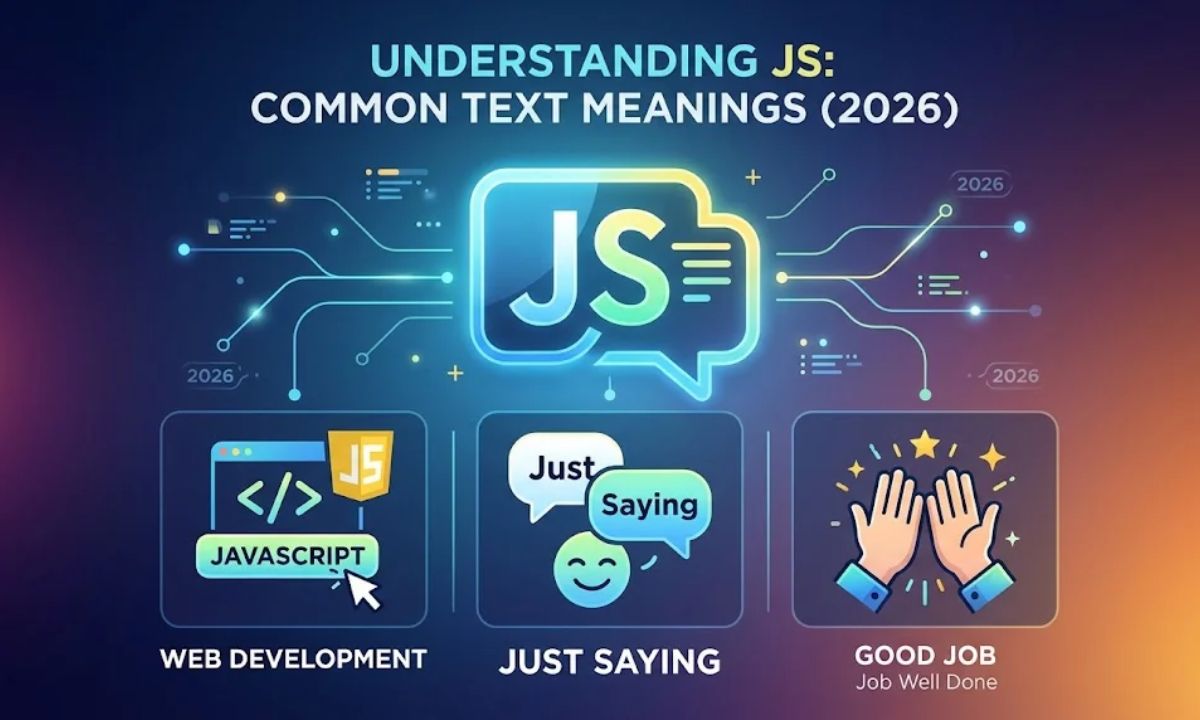
If you have ever received a message that ended with “js” and wondered whether it was a typo, a tech reference, or a subtle hint, you are not alone. The JS meaning in text depends heavily on who is sending the message, where they are sending it, and what the rest of the sentence says. Texting shorthand evolves fast, and two tiny letters can carry very different weight in a group chat, a developer forum, or a sneaker community. This guide explains the JS meaning in text in plain language, shows you how to read the context, and helps you decide when to use it yourself. By the end, you will know every major JS meaning in circulation in 2026.
What Does JS Mean in Text?
In everyday texting and social media, JS most commonly stands for “just saying.” People add it to the end of an opinion, a suggestion, or a mild criticism to soften the blow or to signal that they are not looking for an argument. A friend might write, “That outfit would look better with boots, js,” and the JS meaning here is simple: this is my opinion, take it or leave it.
The second most common JS meaning in text is “just,” used as a lazy, lowercase shortcut. Instead of typing “I’m just leaving work,” a person types “I’m js leaving work.” It saves two seconds and sounds casual, which is exactly the point of most chat abbreviations.
Beyond those two, JS has a handful of meanings that belong to specific communities. Programmers use it for JavaScript, sneaker fans use it for Air Jordans, and recruiters or career sites sometimes use it for “job seeker.” None of these meanings is wrong. They simply live in different corners of the internet, which is why context matters more than the letters themselves.
The abbreviation is also case-flexible. You will see “JS,” “js,” and even “Js” in the wild. Casual chat usually goes lowercase, while technical or professional settings tend to use capitals. That small clue already tells you a lot about the JS meaning intended.
JS Most Common Meanings at a Glance
Here is a quick snapshot of the JS meaning in text you are most likely to meet, ranked by how often people encounter them in 2026:
| Meaning | Where You’ll See It | Example |
| Just saying | Texts, DMs, comments, group chats | “You could’ve called, js.” |
| Just | Fast, casual typing | “I’m js tired today.” |
| JavaScript | Tech forums, coding chats, job posts | “Learning JS this semester.” |
| Air Jordans | Sneaker communities, resale groups | “Picked up some JS yesterday.” |
| Job seeker | Career sites, recruiting messages | “JS profile updated.” |
If you only remember one line from this table, remember this: nine times out of ten, the JS meaning in a casual text is “just saying.”
JS Meaning — “Just Saying”
“Just saying” is the headline answer, and it deserves a closer look because it is the meaning people misread most often. The phrase existed long before texting. People have said “just saying” out loud for decades to cushion a comment. Text messaging shortened it to JS because typing a full phrase on a small keyboard felt like effort, and chat culture rewards speed.
The core JS meaning here is a disclaimer. The sender is offering a thought without demanding that you act on it. It works like a verbal shrug. Compare “You never reply on time” with “You never reply on time, js.” The second version sounds lighter, even though the content is identical.
What’s JS in Chat?
In a chat, JS usually appears at the very end of a message, often after a comma or on its own line. You will see it in several common patterns:
- After a suggestion: “We should leave earlier, js.”
- After an observation: “That movie was way too long, js.”
- After a joke with an edge: “Nice parking job, js.”
- As a standalone reply: A friend sends a blunt opinion, then follows up with a single “js.”
Notice that the placement matters. When JS comes at the end, it is almost always “just saying.” When it appears in the middle of a sentence before a verb or adjective, it is probably the shortened “just.” This position rule is the fastest way to decode the JS meaning in text when you are scrolling through a busy conversation.
It also helps to look at the punctuation. A period after JS makes it feel firm and a little dry. No punctuation feels relaxed. Adding an emoji, such as a smiley or a shrug, usually signals friendliness. The emotional color of the message changes with these tiny details.
The Dual Tone of “Just Saying”
Here is where the JS meaning gets interesting: “just saying” has two opposite tones, and the same two letters can be warm or cold depending on the sentence.
The friendly tone. In many friendships, JS softens honest advice. “Drink some water, js” comes across as caring. The sender wants to help without sounding bossy. In this use, JS lowers the pressure and keeps the mood easy.
The passive-aggressive tone. Other times, JS is a way to deliver a jab while pretending it is harmless. “Some of us actually clean up after ourselves, js” is not a gentle suggestion. It is a complaint wearing a disguise. The abbreviation gives the sender plausible deniability, because they can always say, “I was only saying.”
Because of this split, the JS meaning in text is partly about relationship. Between close friends who joke constantly, it is usually playful. Between coworkers, roommates, or people in the middle of a disagreement, it can feel sharp. If you are on the receiving end and unsure, read the earlier messages. Was the conversation friendly, or was tension already building?
A useful rule: if the sentence before JS would sound rude without it, the sender probably knows it is a jab. If the sentence is neutral or kind without it, JS is likely just a soft closer. Tone, history, and punctuation together reveal the intent far better than the letters alone.
JS Meaning — “Just”
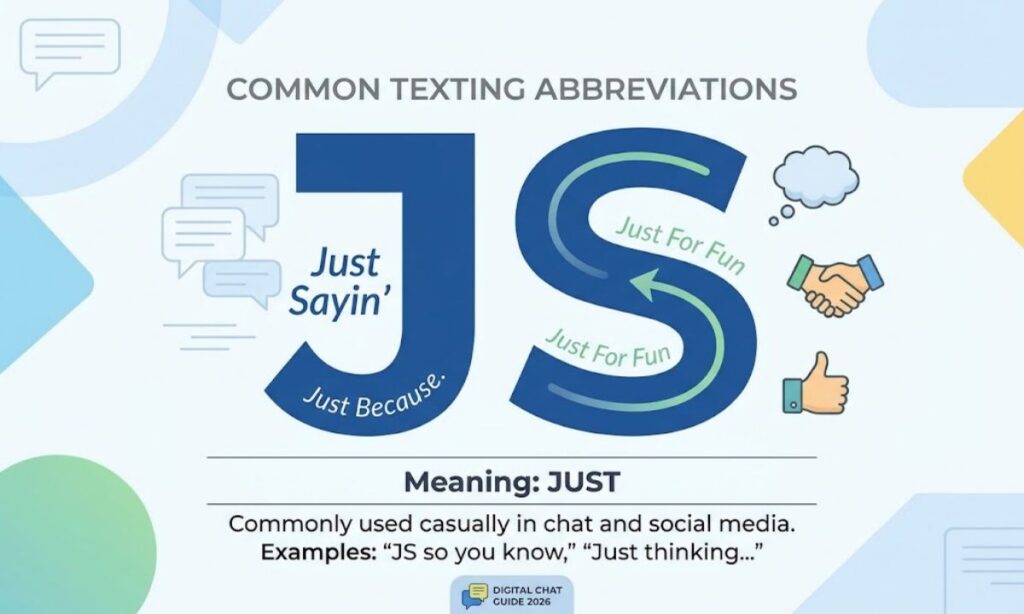
The second major JS meaning is simply the word “just,” shortened. This version is less emotional and more mechanical. People use it the same way they use “rn” for “right now” or “tbh” for “to be honest.” It trims the message without changing the feeling.
Examples include:
- “I’m js gonna stay home tonight.”
- “Js got home, will call you soon.”
- “It was js a joke, relax.”
In each case, replacing JS with the full word “just” keeps the sentence perfectly natural. That substitution test is the easiest way to confirm this JS meaning. If “just” fits grammatically, you have probably found it.
This usage is especially common among younger texters and in fast-moving group chats, where people type in fragments and rarely capitalize. It rarely appears in formal writing, emails to managers, or customer-facing messages. Think of it as a close cousin of “jus” or “jst,” which are other spelling shortcuts for the same word.
One subtle point: “just” itself can minimize or soften. Saying “I’m just checking in” sounds humble. So even in this simple JS meaning, there is often a hint of gentleness or understatement built in.
JS in Other Contexts
Outside casual chat, JS appears in specialized communities. These meanings are less common in everyday texting, but you will bump into them if you spend time in the right spaces. Each one has its own clues, and each is worth knowing so you never misread a message.
JS — JavaScript
For developers and tech-minded people, JS almost always means JavaScript, one of the most widely used programming languages in the world. It powers interactive websites, web apps, browser features, and a large share of modern software tools. File names ending in “.js” are JavaScript files, which is why the abbreviation feels so natural to anyone who writes code.
You will see this JS meaning in text on coding forums, in Discord servers for developers, on job boards, and in classroom chats. Examples include “Do you know JS or Python?” and “My JS keeps throwing an error.” Clues are easy to spot: nearby words like code, bug, function, React, Node, website, or framework point strongly toward JavaScript.
If you are outside the tech world and someone mentions JS in a work conversation, ask a quick follow-up question. A short “JS as in JavaScript?” avoids confusion and shows you care about getting it right.
JS — Air Jordans
Sneaker culture has its own shorthand, and in these circles JS often refers to Jordans, specifically Air Jordan shoes. Collectors, resellers, and fans talk about Js the way other groups talk about a favorite brand. “Got a new pair of Js today” or “Those Js are fire” are typical examples.
This JS meaning tends to show up on social platforms, in resale groups, and in conversations about releases and colorways. The clues are context words like kicks, drop, retro, size, pair, or resell. Sometimes the plural form, “Js,” is the giveaway, since people rarely talk about a single “JS” when discussing shoes.
If you are not part of that community, you can still decode it. Any time a message mentions footwear, a launch date, or a store line, think Jordans before you think “just saying.”
JS — Job Seeker
In career and recruiting spaces, JS can stand for “job seeker.” Recruiters, staffing platforms, and employment forums use it as a quick label for someone looking for work. You may see phrases like “JS profile,” “JS account,” or “JS resume” on job boards and applicant systems.
This is the least common JS meaning in text for regular users, but it matters in professional contexts. If you are browsing a hiring platform and see JS beside a menu option, it almost certainly refers to the job-seeker side of the site, as opposed to the employer side. Context, again, does all the heavy lifting.
All JS Meanings Side by Side
To make everything easy to compare, here is a single reference table covering each JS meaning, its typical setting, and the strongest clue to look for:
| JS Meaning | Typical Setting | Strongest Clue |
| Just saying | Casual chat, DMs, comments | Appears at the end of an opinion |
| Just | Fast texting, group chats | Replaces the word “just” cleanly |
| JavaScript | Tech and coding spaces | Words like code, bug, or website nearby |
| Air Jordans | Sneaker communities | Words like kicks, drop, or pair nearby |
| Job seeker | Career and hiring sites | Words like profile, resume, or account |
Use this table as a cheat sheet. When a message with JS confuses you, check the setting first, then scan for the clue. In most cases, you will land on the correct answer within a few seconds.
How to Tell Which Meaning JS Has
Because the same two letters can mean five different things, decoding them is a skill. Fortunately, a simple process works almost every time.
1. Check the platform. A message on a coding forum is probably about JavaScript. A message in a sneaker group is probably about Jordans. A message in a personal chat is probably “just saying” or “just.”
2. Look at the position. At the end of a sentence, JS usually means “just saying.” Before a verb or adjective, it likely means “just.” As a noun that names a thing, it points to JavaScript, Jordans, or job seeker.
3. Read the nearby words. Technical words, shoe words, and hiring words are strong signals. Emotional words, opinions, and advice point toward “just saying.”
4. Consider the sender. A developer friend and a sneaker-collector friend will use the same letters differently. Your knowledge of the person helps you choose the right JS meaning.
5. Test by substitution. Try replacing JS with each candidate meaning. If “just saying” reads naturally, you are done. If “just” works, great. If neither fits, think about the specialized meanings.
6. Ask when it matters. If the message is important, such as from a manager or a client, a quick clarifying question is better than a wrong guess. Nobody minds a short “what do you mean by JS here?”
With practice, you will decode the JS meaning in text almost automatically, the same way you read other chat abbreviations without thinking.
JS in Gen Z Communication
Gen Z has shaped much of modern texting culture, and JS fits right into it. This generation prefers short, lowercase, low-effort messages that feel relaxed and authentic. Abbreviations like JS let people sound casual without sounding stiff, which matters in a culture that values being real over being polished.
For many younger users, the JS meaning in text leans toward “just saying” with a layer of irony. A message like “ur playlist is mid, js” is delivered with humor, and both people understand that it is half-teasing. The abbreviation signals that no one needs to get defensive.
Gen Z also uses JS in a more neutral “just” sense, stripped of attitude. “js vibing” or “js got here” are quick status updates that cost almost no typing effort. Tone comes from context, emojis, and the relationship between the people chatting.
Meanwhile, the gaming, coding, and sneaker communities that many young people belong to keep the specialized JS meaning alive. A single teenager might use JS to mean “just saying” with friends, JavaScript in a computer science class, and Jordans on a resale app, all in the same afternoon. That flexibility is part of what makes the abbreviation so durable in 2026.
One more trend worth noting: older users sometimes misread JS as rude or dismissive, because they associate “just saying” with passive aggression. Younger users often mean it lightly. Awareness of this generational gap prevents a lot of unnecessary misunderstandings.
When to Use JS — And When Not To
Knowing the JS meaning is only half the story. Knowing when to use it is what keeps your messages friendly and professional.
Use JS When:
- You are texting friends or family in a relaxed conversation.
- You want to share an honest opinion without sounding harsh.
- You are chatting in a community where the specialized meaning is understood, such as a coding server or a sneaker group.
- The topic is lighthearted and the other person knows your sense of humor.
- You are typing quickly and the “just” shortcut will not confuse anyone.
Never Use JS In:
- Formal emails, cover letters, or reports.
- Messages to managers, clients, teachers, or anyone you do not know well.
- Serious or emotional conversations, where it can sound dismissive.
- Arguments or conflicts, since it often reads as passive-aggressive.
- Any situation where the reader may not know which JS meaning you intend.
When in doubt, write out the full phrase. “I’m just saying” or “JavaScript” costs a few extra keystrokes and removes all ambiguity.
Frequently Asked Questions
What does JS mean in text messages?
In most casual text messages, JS means “just saying.” It softens an opinion or suggestion and tells the reader you are not demanding a response.
Is JS rude?
Not by itself. The JS meaning in text can be friendly or passive-aggressive depending on the sentence, the relationship, and the tone of the conversation.
What does JS mean on Snapchat, Instagram, or TikTok?
On social platforms, JS usually means “just saying” or the shortened “just.” In sneaker content, it may also refer to Jordans.
Does JS always mean “just saying”?
No. It can also mean “just,” JavaScript, Air Jordans, or job seeker. Context, position in the sentence, and the platform tell you which JS meaning applies.
Should I use capital or lowercase letters?
Lowercase “js” feels casual and is typical for chat. Capital “JS” is more common for JavaScript and professional contexts.
How do I reply to a message that ends with JS?
Respond to the content of the message, not the abbreviation. If it felt like a jab, you can calmly ask, “Did you mean that as a suggestion?” to clear the air.
Is JS the same as JK?
No. JK means “just kidding” and signals a joke. The JS meaning of “just saying” signals an honest, softened opinion.
Can JS mean something else in 2026?
Slang changes quickly, and small communities invent their own uses. The five meanings in this guide cover nearly every case you are likely to meet, but a quick question never hurts when something seems unclear.
Conclusion
Two letters can say a lot. The JS meaning in text is most often “just saying,” a phrase that softens advice or delivers a gentle, or not so gentle, opinion. It can also be the casual shortcut for “just,” or it can point to specialized worlds such as JavaScript, Air Jordans, and job seekers. Every JS meaning makes sense once you check the platform, the position in the sentence, the nearby words, and the relationship between the people talking.
The best habit is to read the context before reacting. A friendly “js” from a close friend is not the same as a clipped “JS.” from someone you are arguing with. When you write it yourself, save it for relaxed conversations and spell things out when clarity matters.
Now that you understand the JS meaning in text from every angle, you can read messages with confidence, reply with the right tone, and avoid the awkward misunderstandings that tiny abbreviations sometimes cause. Language keeps changing, but the principle stays the same: context is everything.

Liam Joseph Miller is an English language writer and content creator focused on grammar, spelling, vocabulary, and writing. He creates simple, easy-to-understand guides that help readers learn English and avoid common language mistakes. Through OkayMegazines, Liam shares practical explanations, examples, and useful language tips for students, writers, and everyday English learners.