


Ever typed “deeply engrained” and wondered if your spell-checker missed something? You’re not alone. Ingrained vs Engrained: Which Spelling Is Correct? 2026 is a question writers, students, and bloggers search constantly. Both spellings mean “deeply fixed or established,” but Merriam-Webster lists ingrained as the standard form and engrained as a less common variant. In this guide, you’ll learn the meaning of each word, see real examples, compare synonyms, and avoid mix-ups with “engraved” and “ingrown.” You’ll also find clear rules for American and British English, plus tips for formal writing. By the end, you’ll know exactly which spelling to use, every time.
Quick answer:
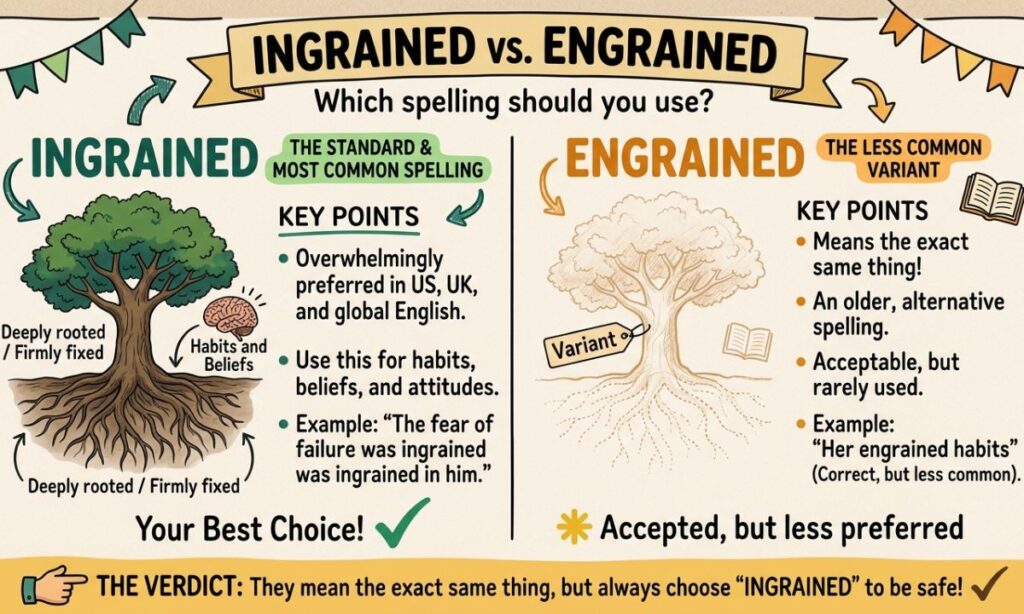
“Ingrained” and “engrained” mean the same thing. “Ingrained” is the standard, more common spelling, and “engrained” is a less common variant. Use “ingrained” unless you have a specific reason not to.
What Does Ingrained Mean?
“Ingrained” means deeply fixed, firmly established, or hard to remove or change. It describes habits, beliefs, or traits that have become part of someone or something over time.
Merriam-Webster defines the verb “ingrain” as working something indelibly into the natural texture or the mental or moral makeup of a person or thing.
You can use it for:
- Habits: brushing your teeth every night
- Beliefs: respect for elders
- Fears: a fear of public speaking
- Physical marks: dirt pressed deep into fabric or wood
Ingrained in Different Contexts
The word works in many settings.
1. Personal habits
Waking up at 6 a.m. is so ingrained that she doesn’t need an alarm.
2. Culture and tradition
Hospitality is deeply ingrained in the community.
3. Psychology and behavior
His fear of failure was ingrained from childhood.
4. Workplace culture
Safety checks became ingrained in the team’s routine.
5. Physical objects
Oil was ingrained in the mechanic’s hands after years of work.
6. Social attitudes
Old prejudices can stay ingrained for generations.
The word often carries a slightly negative feel when it describes something hard to change, such as bad habits. It can also be positive, as in “ingrained kindness.”
What Does Engrained Mean?
“Engrained” is a less common spelling of “ingrained,” and it carries the same meaning. Merriam-Webster lists “engrain” and “engrained” as less common variants of “ingrain” and “ingrained.”
So if you write “engrained habits,” most readers will understand you. Dictionaries do not treat it as a different word.
Some websites claim “engrained” refers to physical things and “ingrained” refers to ideas. That split is not supported by the major dictionaries, and writers use both spellings for both senses. Treat that rule as a style preference, not a fact.
Here are examples using “engrained”:
- The habit was deeply engrained in her routine.
- Dust was engrained in the old wooden floor.
Both are acceptable, though “ingrained” would be the safer choice.
Ingrained vs Engrained Comparison Table
This table shows how the two spellings compare.
| Feature | Ingrained | Engrained |
| Meaning | Deeply fixed or established | Same meaning |
| Status | Standard spelling | Less common variant |
| Frequency | Far more common | Rare |
| Dictionary entry | Main headword | Listed as a variant |
| Verb form | Ingrain | Engrain |
| Use in formal writing | Preferred | Acceptable but uncommon |
| Risk of seeming like an error | Very low | Higher, since some editors flag it |
| Example | “Honesty is ingrained in her.” | “Honesty is engrained in her.” |
Key takeaway: The meanings match, but the spelling choice affects how polished your writing looks.
Engrained vs Ingrained Synonym
Neither spelling is stronger or weaker than the other, so synonyms work for both. Here are useful alternatives.
| Synonym | Best Used For | Example |
| Deep-seated | Beliefs, emotions | A deep-seated fear of failure |
| Entrenched | Systems, habits | Entrenched attitudes |
| Rooted | Traditions, culture | Rooted in history |
| Embedded | Physical or abstract things | Embedded in the culture |
| Inherent | Natural qualities | An inherent talent |
| Habitual | Behaviors | Habitual lateness |
| Fixed | General use | Fixed ideas |
| Established | Formal writing | Established practices |
| Inbred | Traits seen as inborn | Inbred caution |
| Ground-in | Dirt and stains | Ground-in dirt |
Tip: Use a synonym when you want to avoid repeating the same word, or when you want a more precise tone. “Entrenched” works well for systems, while “deep-seated” fits emotions.
Engrained vs Ingrained Examples
Seeing both spellings in sentences makes the pattern clear.
Examples with “Ingrained” (Recommended)
- Punctuality is ingrained in our company culture.
- Ingrained habits are the hardest to break.
- He had an ingrained distrust of strangers.
- The dirt was ingrained in the carpet fibers.
- Respect for nature is ingrained in the local traditions.
Examples with “Engrained” (Acceptable Variant)
- Fear of public speaking was engrained in him from school.
- Grease was engrained in the old workshop table.
- The idea is deeply engrained in the culture.
Quick Comparison
| Sentence | Verdict |
| “Good manners are ingrained in her.” | Standard and safe |
| “Good manners are engrained in her.” | Acceptable, but less common |
Ingrained vs Engraved
These two look similar but mean very different things.
| Word | Meaning | Example |
| Ingrained | Deeply fixed in a person or thing | “Kindness is ingrained in him.” |
| Engraved | Carved or cut into a hard surface | “His name was engraved on the ring.” |
Easy way to remember: If you can picture a tool cutting into metal, stone, or wood, the word is engraved. If you mean a deep habit, belief, or trait, use ingrained.
The Key Difference — Convention Over Correctness
The real story of ingrained vs engrained is not about right and wrong. Both spellings are recognized. The difference is about convention, meaning which spelling most writers and editors expect.
Think of it like this:
- Correctness asks, “Does the word exist?” Here, both do.
- Convention asks, “Which spelling do readers expect?” Here, the answer is “ingrained.”
Writers who choose “engrained” are not making a serious mistake, but they may attract extra attention from editors or readers who think it is a typo. In professional writing, avoiding that distraction matters.
Why “Ingrained” Won
Several factors explain why “ingrained” became the standard.
- Dictionary preference. Major dictionaries list “ingrain” as the main entry and “engrain” as a variant.
- The “in-” prefix. English uses “in-” in many words about putting something into something, such as “instill” and “implant,” so “ingrain” feels natural.
- Repetition. Once editors and publishers favored one spelling, it spread through books, news, and education.
- Usage data. Writing guides that compare usage over time report that “ingrained” is much more frequent than “engrained” in both American and British English.
- Origin of the idea. The word comes from the old notion of working color “in grain,” meaning deep into the fibers of cloth. The “in” fits that idea of going inside.
Over time, popularity turned into a rule of thumb: pick “ingrained.”
When to Use Ingrained vs Engrained
Always Use “Ingrained” When:
- You are writing for school, work, or publication
- You are following a style guide such as AP, Chicago, or APA
- You want to avoid distracting your reader
- You are writing for a global audience
- You are unsure which spelling to pick
- You are optimizing content for search, since most people search for “ingrained”
Rule of thumb: If in doubt, write “ingrained.”
“Engrained” Is Acceptable When:
- You are quoting a text that uses it, such as an older book or article
- Your style guide or publisher specifically allows it
- You are matching the spelling choice used elsewhere in the same document
- You are writing casually and the variant feels natural
Even then, stay consistent. Do not use “ingrained” in one paragraph and “engrained” in the next.
Common Mistakes to Avoid
| Mistake | Problem | Fix |
| Mixing both spellings in one document | Looks inconsistent | Pick one and stick to it |
| “Ingrown” instead of “ingrained” | Different word (like an ingrown toenail) | Use “ingrained” |
| “Engraved” instead of “ingrained” | Means carved, not deeply fixed | Use “ingrained” for habits and beliefs |
| “Ingrained in grained” or “in grain” | Spelling confusion | Write “ingrained” as one word |
| Assuming “engrained” is always wrong | It is a recognized variant | Treat it as acceptable but uncommon |
| Believing “engrained is physical, ingrained is mental” | Not supported by major dictionaries | Use either spelling for both senses |
More tips:
- Use “ingrained” before nouns (“ingrained habit”) or after verbs (“is ingrained”).
- Watch for “ingrained in” and “ingrained into.” Both appear, though “ingrained in” is more common.
- Avoid overusing the word. If every habit in your article is “deeply ingrained,” try a synonym.
Ingrained vs Engraved — An Important Distinction

Because these two are often mixed up, here is a closer look.
Engraved is the past tense of “engrave,” which means to cut or carve letters or designs into a hard surface.
- A trophy has the winner’s name engraved on it.
- A wedding ring may have a date engraved inside.
- Tombstones are engraved with names.
Ingrained is about depth in character, habit, or texture.
- A habit is ingrained.
- A belief is ingrained.
- Dirt can be ingrained in fabric.
You can even combine the ideas in a figure of speech. A teacher might say, “These rules should be ingrained in your mind, not just engraved on the wall.” The first describes mental depth, and the second describes a physical carving.
Frequently Asked Questions
Is it ingrained or engrained?
“Ingrained” is the standard and more common spelling. “Engrained” is an accepted but less common variant.
Do ingrained and engrained mean the same thing?
Yes. Major dictionaries treat them as spelling variants with the same meaning.
Is engrained a real word?
Yes. It is listed as a less common variant of “ingrained” in dictionaries like Merriam-Webster.
Which spelling is more common?
“Ingrained” is far more common in both American and British English.
Is engrained wrong in formal writing?
It is not wrong, but “ingrained” is safer because it is what most editors and readers expect.
What is the difference between ingrained and engraved?
“Ingrained” means deeply fixed, as in a habit, while “engraved” means carved into a surface.
Is ingrained the same as ingrown?
No. “Ingrown” describes something growing inward, like a toenail, and is unrelated to “ingrained.”
Does engrained refer to physical things only?
No. Some websites suggest that, but dictionaries do not make that distinction.
What are good synonyms for ingrained?
Deep-seated, entrenched, rooted, embedded, inherent, and habitual all work.
Which spelling should I use for SEO or blogging?
Use “ingrained,” since it is the form most people search for and expect to read.
Conclusion
The ingrained vs engrained question has a simple answer. Both spellings mean “deeply fixed or established,” but ingrained is the standard choice and the one most readers expect. “Engrained” is a recognized variant, best saved for quotes or cases where a style guide allows it.
Remember three quick points. First, pick “ingrained” when you are unsure. Second, stay consistent within a document. Third, do not confuse it with “engraved,” which means carved, or “ingrown,” which is an unrelated word.
Now that you know how ingrained vs engrained works, you can write with confidence in emails, essays, blog posts, and reports. Share this guide with anyone who keeps second-guessing the spelling, and keep “ingrained” as your default.

Liam Joseph Miller is an English language writer and content creator focused on grammar, spelling, vocabulary, and writing. He creates simple, easy-to-understand guides that help readers learn English and avoid common language mistakes. Through OkayMegazines, Liam shares practical explanations, examples, and useful language tips for students, writers, and everyday English learners.