

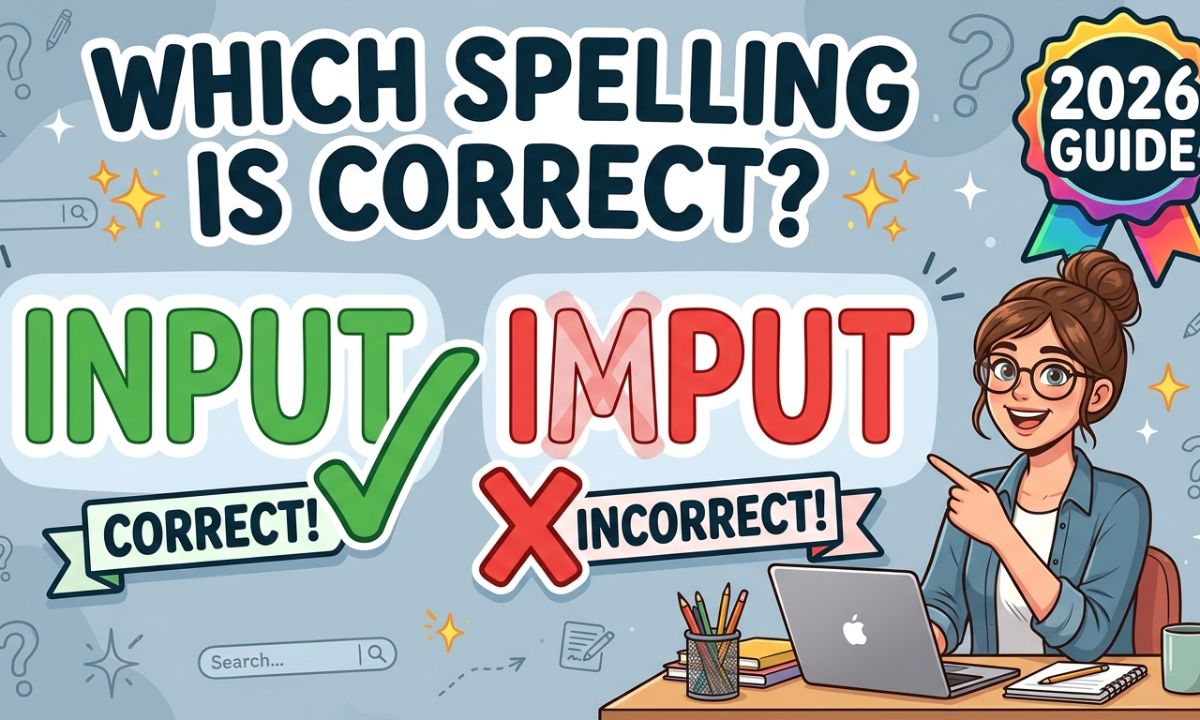
Many writers pause before typing a word they say every day. Input or imput is one of those pauses. The two look alike, and they sound alike when you speak fast.
This guide settles the question. You will learn what “input” means, why “imput” appears, how “impute” fits in, and how to write all of them correctly in 2026.
Quick answer:
“Input” is the correct spelling. “Imput” is a common misspelling and not a standard English word. When you mean data, advice or contribution, always write “input.”
What Does Input Mean?
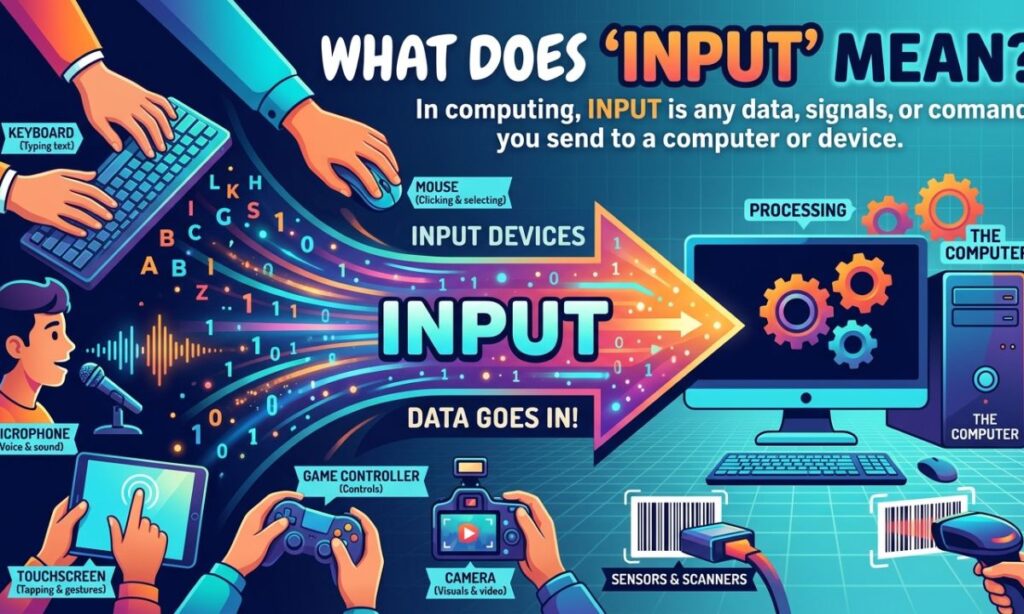
“Input” is a noun and a verb. Put simply, it means something that is put into a system, a process or a discussion.
Used as a noun or a verb, it can describe both data entered into a machine and an opinion offered to a person. That is why you hear it in offices, classrooms and computer labs.
The word is a compound of “in” and “put.” That compound structure is what makes the spelling “input” logical.
Input as Contribution or Advice
In everyday talk, “input” means someone’s ideas, feedback or opinion.
- “Your input is essential to the success of this project.”
- “I need your input on what to have for dinner.”
- “Thanks for your input” means “thanks for your advice or comments.”
In this sense, it often works as a mass noun, like “advice.” Some US writers avoid adding an s to this meaning.
Input as Data Entry
As a verb, “input” means to enter data into a computer or form.
- “Please input your password.”
- “It is vital to input data into the company CRM as soon as you receive it.”
Both examples come from typical business writing, where data entry is a daily task. Keep in mind that “enter” or “type in” often sounds more natural in casual writing.
Input as a Technical or Scientific Term
In engineering and science, an input is whatever goes into a system.
- Computing: Data from a keyboard, mouse or microphone is input.
- Electronics: A signal or power fed into a device is input.
- Economics: Labour, materials and capital are inputs to production.
- Science: An input is any quantity or energy added to a process, while the result is the output.
Typical input devices include a microphone, keyboard or mouse.
Input or Imput Word Forms at a Glance
| Form | Part of speech | Example |
| input | Noun / verb (base form) | “We value your input.” |
| inputs | Plural noun / third-person verb | “The system has three inputs.” |
| inputting | Present participle | “She is inputting the figures.” |
| input | Past tense | “He input the data yesterday.” |
| inputted | Past tense (also accepted) | “He inputted the data yesterday.” |
| inputter | Noun (rare) | “The inputter checked each row.” |
What Does Imput Mean?
Quick answer:”Imput” has no standard meaning. It is simply a misspelling of “input.”
One guide calls it a “ghost word,” often heard but not actually a real word. Even so, people usually understand what the writer meant.
A few informal dictionaries list it. One labels it only a pronunciation spelling of “input.” That is not an endorsement for formal writing.
Treat “imput” as an error in essays, emails, reports and code comments.
Why People Write “Imput”
There are three common reasons:
- Pronunciation. Fast speech can blur “in” into “im.”
- Keyboard slips. The M key sits right beside the N key.
- Pattern copying. Words like “impact,” “impose” and “import” begin with “im.”
Even programmers fall for it. In one Unity forum thread, a developer hit a compile error because of “Imput,” and the fix was to change it to “Input.”
Spell-checkers usually catch this. Open-source tools like codespell also hold lists of common typos, including nearby ones like “inpout.”
The Linguistic Explanation
The pull toward “im” has a real reason. English often changes the prefix “in-” to “im-” before the letters b, m and p. That is called assimilation: the mouth prepares for the next sound.
Compare these correct words:
| Word | Prefix change | Why |
| impossible | in- → im- | Followed by “p” |
| imbalance | in- → im- | Followed by “b” |
| immobile | in- → im- | Followed by “m” |
| impatient | in- → im- | Followed by “p” |
So “imput” feels natural. But “input” is not a prefix word at all. The prefix “im-” means “not,” and “input” does not mean “not put.”
It is a plain compound: “in” + “put.” The word is pronounced “IN-poot.”
Imput or Impute — An Important Distinction
“Impute” is a real word, and that is why people sometimes get confused.
Impute (im-PYOOT) is a verb. It means to attribute something, often a fault or a value, to someone or something.
- “The report imputes the delay to poor planning.”
- “Analysts impute missing values in the dataset.”
Since “impute” has an entirely different meaning, the right fix for “imput” is “input.”
A quick memory trick:
- Input = something you put in.
- Impute = something you assign (to a cause or a person).
Imput or Impute or Input Comparison Table
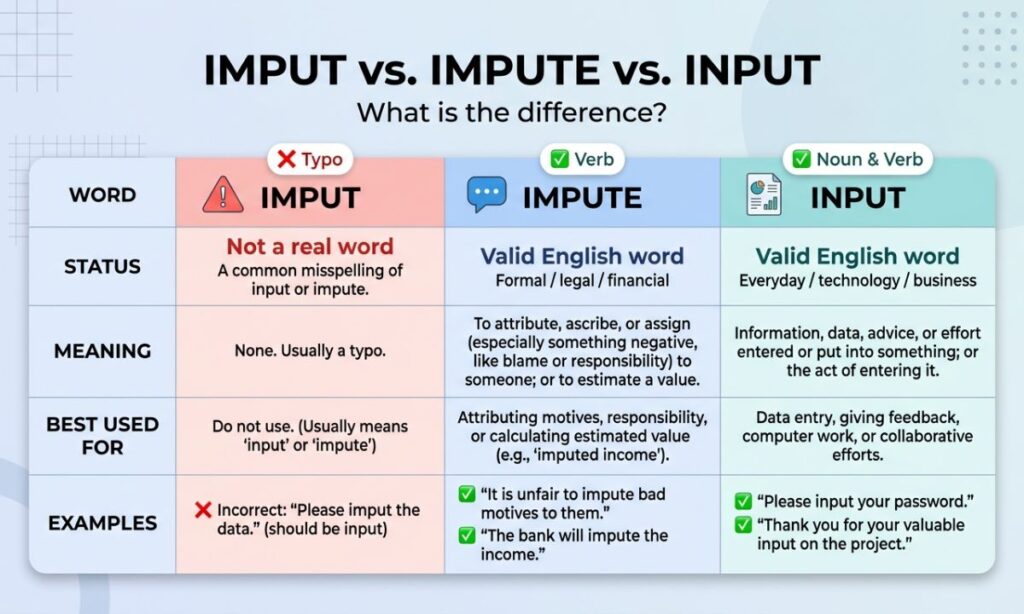
| Term | Correct? | Part of speech | Meaning | Example |
| Input | Yes | Noun / verb | Something put in; data, advice | “Add your input here.” |
| Impute | Yes | Verb | Attribute or assign | “They impute blame to him.” |
| Imput | No | None | Misspelling of “input” | ❌ “Add your imput.” |
Remember: when in doubt, use “input.” It is right in nearly every case where “imput” tempts you.
Past Tense of Input — Input or Inputted?
Quick answer: Both “input” and “inputted” are accepted as the past tense. “Input” is often preferred in careful writing.
Dictionaries accept both, even though the verb comes from “put,” which rarely becomes “putted.” Some sources list both forms as past participles.
Why the debate? Some writers reason like this. Since “put” stays “put” in the past, they feel “input” should stay “input.” Others find “inputted” clear and easy to read.
Here is a simple guide:
| Situation | Better choice | Example |
| Formal or editorial writing | input | “She input the figures.” |
| Technical documentation | input or inputted | “The data was inputted.” |
| Consistency inside one document | Pick one and stick to it | — |
Never use “imputted.” That is another spelling error.
When to Use Input Correctly
Use “input” when you mean any of the following:
- Advice or feedback: “We welcome your input.”
- Data you enter: “Input the code below.”
- A signal or resource into a system: “The circuit has two inputs.”
Avoid it when a plainer word fits better. Some readers dislike “input” as computer jargon in business writing. You might say “suggestions,” “comments” or “feedback” instead.
In Professional and Workplace Communication
Clear workplace writing matters. A typo in a client email can look careless.
Good examples:
- “Please share your input by Friday.”
- “The team’s input shaped the final plan.”
- “We need legal input before launch.”
Better alternatives when you want variety:
- feedback
- suggestions
- comments
- contribution
- perspective
In Technology and Data Contexts
In tech, spelling “input” correctly can prevent real errors. Code, form fields and file names are case-sensitive and exact.
- HTML: <input type=”text”> is the correct tag. “Imput” would not work.
- Programming: Functions like input() in Python only work with the right spelling.
- User interface: Labels such as “Input field” and “Input device” should be consistent.
- Data work: “Input data,” “input variables” and “input layer” are standard terms.
The Unity example above shows how one misplaced letter can break a program.
Common Mistakes to Avoid
- Writing “imput.” Always “input.”
- Writing “imputted.” Use “input” or “inputted.”
- Mixing up “impute.” Use it only to mean “attribute.”
- Overusing it as jargon. Swap it for “feedback” when the context is casual.
- Inconsistent past tense. Do not switch between “input” and “inputted” in the same text.
- Pluralising incorrectly. The plural is “inputs,” not “inputes.”
- Trusting memory over spell-check. Proofread the final draft.
Frequently Asked Questions
Is it “input” or “imput”?
“Input” is correct. “Imput” is a misspelling.
Is “imput” a real word?
No. It is described as a commonly misused spelling and pronunciation of “input.”
Why do people say “imput”?
Fast speech and the M and N keys sitting next to each other cause most slips.
What does “input” mean?
It means something put into a system, such as data, or an opinion offered to a group.
Is “impute” the same as “input”?
No. “Impute” means to attribute something to a cause or person.
What is the past tense of “input”?
Both “input” and “inputted” are accepted. “Input” is often preferred in formal writing.
Is “inputted” correct?
Yes. It is listed as an acceptable past tense alongside “input.”
Can “input” be plural?
Yes, “inputs” is the plural, especially in technical contexts. For advice, many writers use it as a mass noun.
How do I remember the right spelling?
Think “in” + “put.” You put something in, so it is “input.”
What can I use instead of “input”?
Try “feedback,” “suggestions,” “comments,” or “contribution.”
Conclusion
The input or imput question has a clear answer: write “input.” It comes from “in” and “put,” and it covers data, advice and technical signals.
“Imput” is not a real word, and “impute” is a separate verb with its own meaning. For the past tense, “input” and “inputted” both pass, so pick one and stay consistent.
Next time you doubt the spelling, remember the simple rule: you put something in. Bookmark this 2026 guide, and your writing will stay clean, correct and professional.

Liam Joseph Miller is an English language writer and content creator focused on grammar, spelling, vocabulary, and writing. He creates simple, easy-to-understand guides that help readers learn English and avoid common language mistakes. Through OkayMegazines, Liam shares practical explanations, examples, and useful language tips for students, writers, and everyday English learners.