

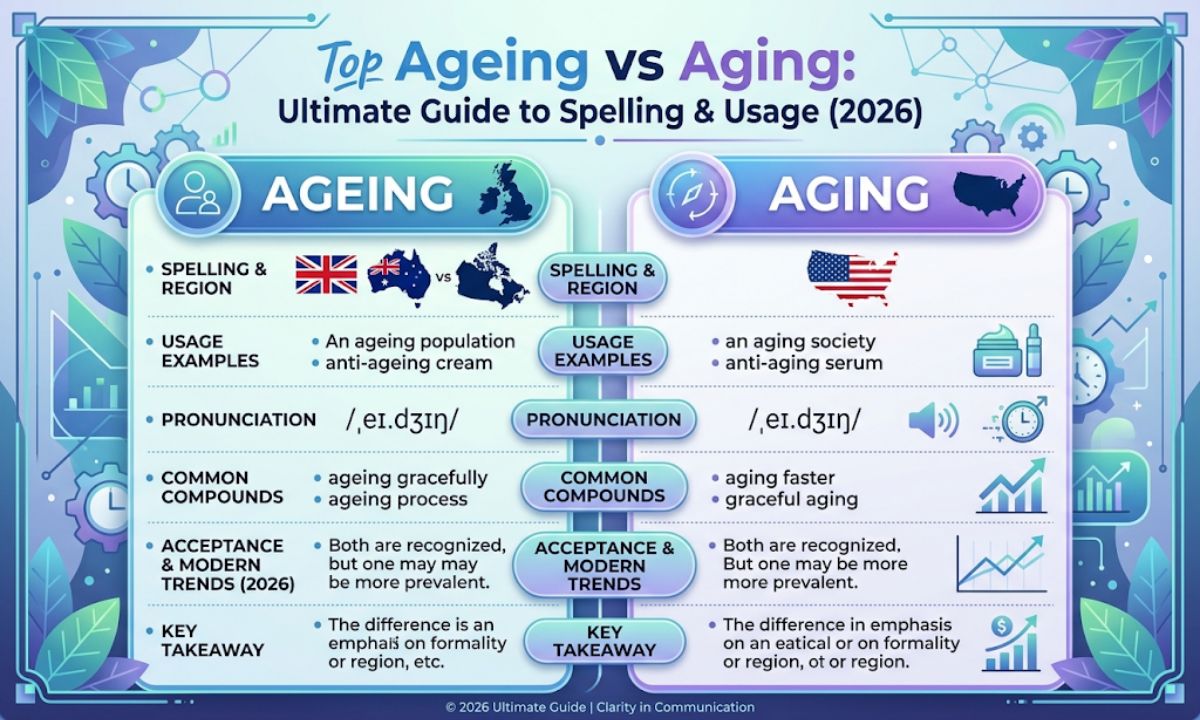
Few spelling questions cause as much hesitation as ageing vs aging. The two words look nearly identical, they carry exactly the same meaning, and yet choosing the wrong one for your audience can make polished writing look careless. If you have ever paused over a sentence wondering whether to keep or drop the middle “e,” this guide to ageing vs aging is written for you.
Here is the short answer up front: both spellings are correct. The only real difference is geography. Americans and Canadians write “aging,” while British, Australian, and most Commonwealth writers prefer “ageing.” Once you understand that simple rule, the ageing vs aging debate stops being confusing and becomes a quick style decision.
In the sections below, we cover the meaning of the word, the regional split, a comparison table, the one important exception (ageism), the history behind the difference, and practical advice for choosing the right form in 2026. We also answer the most common questions and highlight the mistakes writers make most often.
What Does Aging / Ageing Mean?
Before comparing spellings, it helps to be clear about the word itself. Aging (or ageing) refers to the process of growing older: becoming mature, developing over time, or showing the effects of the years. Depending on the sentence, it can work as a noun, as the present participle of the verb “to age,” or as an adjective.
As a noun: “Aging is a natural part of life.” As a verb form: “The wine is aging in oak barrels.” As an adjective: “The aging population is placing new demands on healthcare systems.”
The word is not limited to people. We talk about ageing cheese, ageing bridges, ageing software, ageing aircraft, and ageing whisky. In every case the idea is the same: something is changing as time passes. Scientists use the term in biology, gerontology, and materials science, while journalists rely on it when discussing demographics, pensions, and public policy.
The meaning never changes from one region to another. Whichever spelling you choose, the definition stays identical. That is why ageing vs aging is purely a question of spelling convention, not of meaning, tone, or grammar.
Aging vs Ageing — The Regional Difference
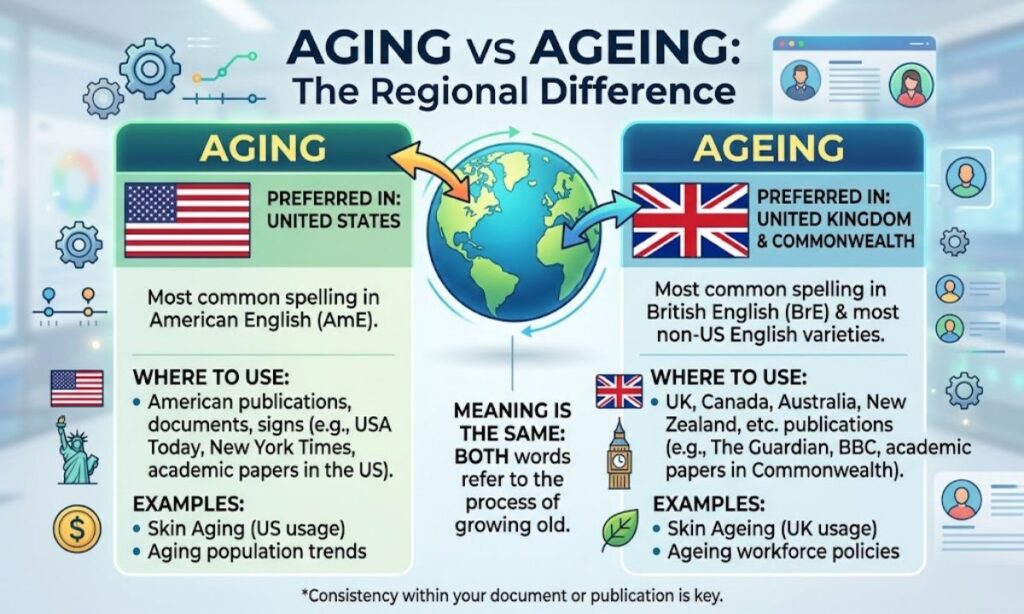
The clearest way to understand ageing vs aging is to look at where each form is used. English has no single governing authority, so spelling conventions developed separately in different parts of the world. Today two broad camps exist, and the ageing vs aging divide falls neatly along their lines.
How Do You Spell Aging?
Learners often ask, “How do you spell aging?” The honest answer is: it depends on where you live and who you are writing for. In American and Canadian English, the standard form is a-g-i-n-g, with no “e” in the middle. In British English, the standard form is a-g-e-i-n-g, with the “e” kept. If your readers are mostly in the United States, write “aging.” If they are mostly in the United Kingdom, write “ageing.” If your audience is global, choose one and stay consistent.
Aging — American and Canadian English
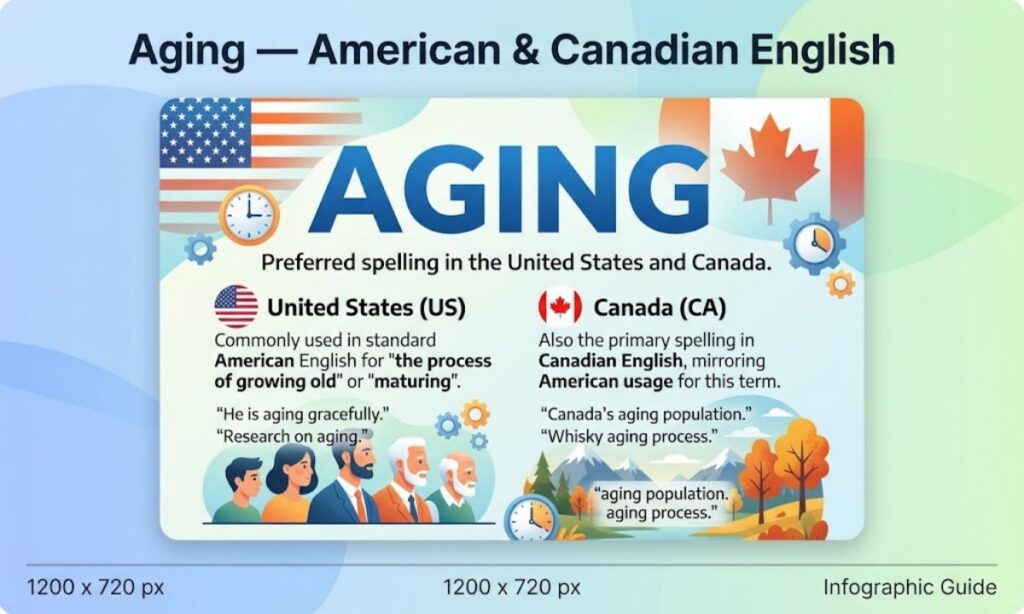
In the United States and Canada, the dominant spelling is “aging.” Major American references, including the Associated Press Stylebook, the Chicago Manual of Style, and Merriam-Webster, treat “aging” as the standard form. Canadian publications largely follow the same pattern, even though Canadian English keeps British spellings in words such as “colour” and “centre.”
Here are a few examples of the American form in use:
- “The National Institute on Aging funds research on healthy longevity.”
- “Anti-aging products are a multibillion-dollar industry.”
- “Our aging infrastructure needs urgent investment.”
In this camp, the silent “e” is dropped when the suffix “-ing” is added to “age.” That follows a familiar rule of English spelling: a final silent “e” is usually dropped before a suffix beginning with a vowel. It is the same rule that turns “bake” into “baking,” “hope” into “hoping,” and “make” into “making.”
Ageing — British, Australian, and Commonwealth English
In the United Kingdom, Australia, New Zealand, Ireland, India, South Africa, and many other Commonwealth countries, “ageing” is the preferred spelling. The Oxford English Dictionary, Cambridge Dictionary, and major British newspaper style guides favour the form with the “e.”
Examples of the British form:
- “The government has published a strategy for an ageing society.”
- “The ageing process affects skin, bones, and memory.”
- “Ageing Research Reviews is a respected scientific journal.”
The international health community also tends to use this spelling. The World Health Organization, for instance, titled its global initiative the “Decade of Healthy Ageing.” If you read international policy documents, you will see “ageing” far more often than in American publications.
Some British dictionaries list “aging” as an acceptable variant, but it is noticeably less common outside North America. For readers in these regions, “ageing” is the safer choice.
Ageing vs Aging Comparison Table
For a quick reference, this ageing vs aging comparison table summarises the key points in one place.
| Feature | Aging | Ageing |
| Preferred region | United States, Canada | UK, Australia, New Zealand, Ireland, India, South Africa |
| Spelling rule | Silent “e” dropped before “-ing” | Silent “e” retained before “-ing” |
| Meaning | Process of growing older | Process of growing older |
| Part of speech | Noun, verb form, adjective | Noun, verb form, adjective |
| Typical style guides | AP, Chicago, Merriam-Webster | Oxford, Cambridge, Guardian |
| Example | “An aging population” | “An ageing population” |
| Related term | Ageism | Ageism |
| Acceptable worldwide? | Understood everywhere | Understood everywhere |
The last two rows are the most important. Both spellings are understood everywhere, and the related word “ageism” is spelled the same way in both camps. The table shows that the only genuine difference lies in the middle of the word.
The Important Exception — Ageism
One word breaks the pattern, and it is worth knowing: ageism. This term describes prejudice or discrimination based on a person’s age, and it is spelled “ageism” in both American and British English. You will never see “agism” in standard writing, and you will not see an American version that drops the “e.”
Why does the “e” survive here, even in the United States? The reason is that “ageism” is built differently. It is formed by adding the suffix “-ism” to the base word “age.” Dropping a silent “e” before a suffix is a habit tied mainly to suffixes that begin with a vowel, and writers also want the root “age” to remain easy to spot. Keeping the “e” makes the word look and read clearly: age plus ism.
The term was coined in 1969 by the gerontologist Robert Butler, and it has been spelled “ageism” ever since. So even if you follow American conventions and write “aging,” you should still write “ageism.” The same goes for related forms such as “ageist,” “ageless,” and “aged.”
Ageing Definition in Plain Terms
If you are looking for a simple ageing definition, here it is: ageing is the gradual process by which a living thing or an object changes as time passes, usually involving maturity, decline, or both. In biology, it describes the accumulation of cellular and physiological changes over a lifespan. In everyday speech, it describes anything that is becoming older. The ageing definition is the same as the definition of aging, so you can use whichever spelling your audience expects.
Why the Spelling Difference Exists

To understand why ageing vs aging exists at all, we need a short trip through the history of English. The word “age” entered English from Old French, which in turn traces back to Latin roots related to a span of life or time. Medieval spelling was unstable, and writers used many variants before the forms we know today settled.
The split between British and American spellings widened in the nineteenth century. Noah Webster, the American lexicographer, championed simpler and more systematic spelling. His reforms helped shape American forms such as “color,” “center,” and “defense.” Because American writers were already comfortable dropping unnecessary letters and following the standard rule about silent “e,” “aging” fit naturally into the American system.
British English, by contrast, tended to preserve older and more conservative spellings. Retaining the “e” in “ageing” keeps the base word “age” fully visible, which many British editors prefer. British usage also keeps the “e” in some other words, such as “singeing” (to avoid confusion with “singing”) and “dyeing” (to avoid confusion with “dying”). That habit of protecting the visible root of a word helps explain why “ageing” feels natural to British readers.
Usage data from large text collections suggest that “aging” overtook “ageing” in American writing during the twentieth century, while “ageing” stayed dominant in British publishing. In other words, the ageing vs aging difference is the product of history, editorial habit, and national style rather than any rule of logic. Neither spelling is older, better, or more correct in an absolute sense.
Which Spelling Should You Use?
When you are deciding between the two, the best approach is practical. Ask who your readers are, and follow these guidelines to settle the ageing vs aging question quickly.
1. Match your audience. Writing for a US or Canadian audience? Use “aging.” Writing for readers in the UK, Australia, New Zealand, India, or Ireland? Use “ageing.” This single rule resolves most cases.
2. Follow the publication’s style guide. If you are writing for a journal, newspaper, university, or company, check its style sheet. Academic journals especially tend to enforce one spelling system throughout. For example, a journal titled Aging Cell uses the American form, while Ageing and Society uses the British one.
3. Be consistent. Whichever form you choose, use it throughout the entire document, including headings, captions, alt text, and metadata. Mixing both in one article is the most visible mistake you can make.
4. Set your spellchecker correctly. Switch your word processor or browser to English (US) or English (UK) so that it flags the spelling you did not intend.
5. Think about search and discoverability. If you publish online, consider where most of your readers are located. A site aimed mainly at Americans will likely find that more people search for “aging,” while a site for a British audience should lean on “ageing.” Some publishers deliberately mention both forms once, naturally, to cover both audiences.
6. Keep proper names intact. Organisations, laws, and publications have official names. The U.S. National Institute on Aging keeps its American spelling, and the WHO’s Decade of Healthy Ageing keeps its British one. Never change the spelling inside a proper name or a direct quotation.
Over Ageing, Overaging, and Hyphen Questions
A common follow-up concerns compounds such as “over ageing.” Writers sometimes split it into two words, but the standard forms are “over-ageing” or “overageing” in British English and “over-aging” or “overaging” in American English. These terms appear in wine, cheese, and whisky production, where leaving a product to mature for too long can spoil it. The same regional rule applies: keep the “e” for British audiences and drop it for American ones. Check your style guide on hyphenation, because dictionaries and publishers differ, and avoid writing the phrase as two separate words unless the sentence genuinely needs it, as in “the barrels are over ageing guidelines.”
Common Mistakes to Avoid

Even exprienced writers slip up on ageing vs aging. Watch out for these common errors:
- Mixing both spellings in one document. If the headline says “ageing” and the body says “aging,” readers notice immediately. Pick one and apply it everywhere.
- Writing “agism.” The correct spelling is “ageism.” The “e” stays in both regions.
- Treating one spelling as a typo. Neither form is wrong. Correcting a British writer’s “ageing” to “aging” (or the reverse) without checking the audience can introduce errors rather than fix them.
- Changing quotations or proper names. If a source uses a particular spelling, reproduce it exactly inside quotation marks and official titles.
- Hyphenating incorrectly. Phrases like “anti-aging cream” and “age-related decline” are standard, but “age-ing” is never correct.
- Forgetting related words. If you adopt a spelling system, apply the same logic to words such as “colour/color” and “centre/center” so the whole piece feels consistent.
- Ignoring metadata. Page titles, URLs, image names, and social posts should use the same spelling as the body text.
- Relying on autocorrect. Autocorrect follows the language setting of your device, which may not match your intended audience. Always proofread the final version.
A useful habit is to run one final search through your document for both spellings. If you find both, decide which camp you belong to and replace the others.
Frequently Asked Questions
1. Is it ageing or aging?
Both are correct. “Aging” is standard in American and Canadian English, while “ageing” is standard in British, Australian, and other Commonwealth English. The ageing vs aging choice depends on your audience.
2. Do ageing and aging mean the same thing?
Yes. They share exactly the same meaning and grammar. The only difference in the ageing vs aging comparison is the presence or absence of the middle “e.”
3. Which spelling is used in the UK?
British English prefers “ageing.” Newspapers, government documents, and dictionaries published in the UK usually follow this form, although “aging” is sometimes seen as a variant.
4. Which spelling is used in the US?
American English uses “aging.” Style guides such as AP and Chicago, along with American dictionaries, treat it as the standard form.
5. How is ageism spelled in American English?
It is spelled “ageism,” the same as in British English. This is the key exception to the usual ageing vs aging pattern, and “agism” is not accepted.
6. Can I use both spellings in the same article?
Only if you are deliberately comparing them, as in an article about ageing vs aging itself. In every other situation, choose one spelling and keep it consistent from the first line to the last.
7. Is one spelling more formal or more correct?
No. Neither form is more formal, more modern, or more accurate. Each is correct within its own regional convention, so the best choice is the one your readers expect.
8. What about “over ageing”?
The usual forms are hyphenated or closed compounds, such as “over-ageing” (British) and “over-aging” (American). Follow the same regional rule you use for the main word.
Conclusion
The ageing vs aging question looks complicated, but the answer is refreshingly simple. Both spellings are correct, both mean the same thing, and the choice depends entirely on your audience. Use “aging” for readers in the United States and Canada, use “ageing” for readers in the United Kingdom and most of the Commonwealth, and always write “ageism” with its “e” regardless of where you are.
The real secret to getting ageing vs aging right in 2026 is consistency. Decide on your target audience, check any style guide you are bound to, set your spellchecker to the matching language, and apply the same spelling to headings, body text, and metadata. Do that, and you will never have to second-guess the spelling again.
Next time someone asks you about ageing vs aging, you will know exactly what to say: it is not a question of right and wrong, only of knowing your readers.

Liam Joseph Miller is an English language writer and content creator focused on grammar, spelling, vocabulary, and writing. He creates simple, easy-to-understand guides that help readers learn English and avoid common language mistakes. Through OkayMegazines, Liam shares practical explanations, examples, and useful language tips for students, writers, and everyday English learners.