

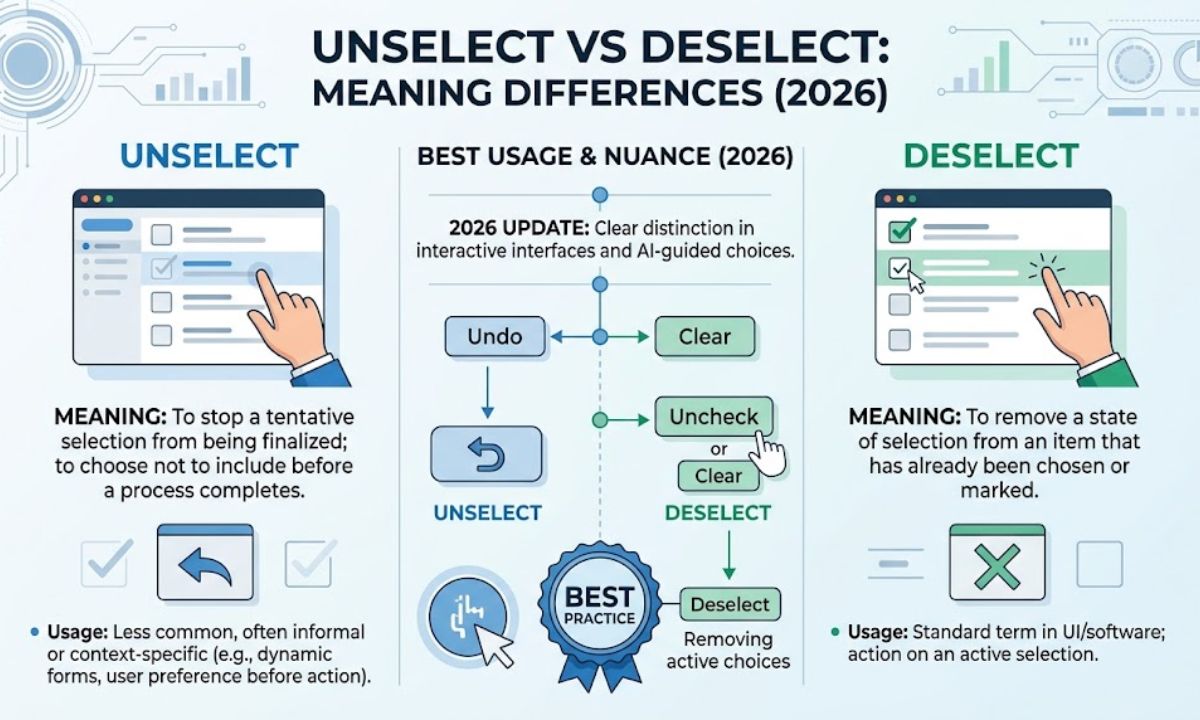
Few word pairs cause as much quiet confusion as unselect vs deselect. Both describe the same simple action: removing a choice you made a moment ago. You tick a checkbox, change your mind, and tick it again. But which word should you use to describe that moment? If you have ever hesitated while writing a help article, a software manual, or a button label, you already know the problem. Some dictionaries list one word and ignore the other, while style guides give mixed advice.
This guide to unselect vs deselect explains what each word means, where each one belongs, and how to choose with confidence in 2026. You will also find a comparison table, practical examples, and a list of common mistakes. By the end, the question of unselect vs deselect should feel simple.
What Does Deselect Mean?
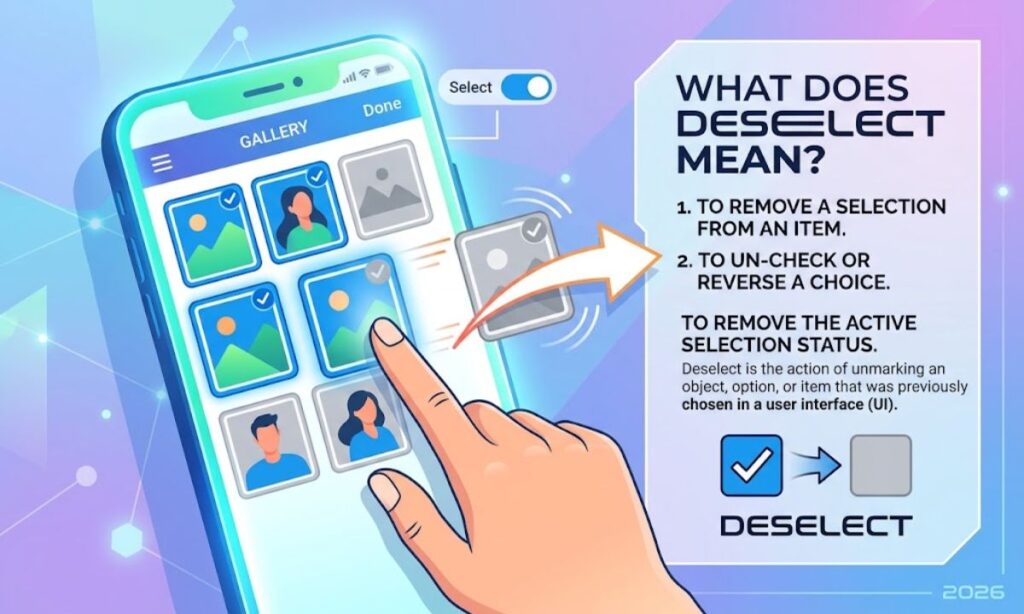
Deselect is a verb that means to cancel or remove a selection that was previously made. If you highlight a paragraph, click a file, or check a box, you have selected it. When you reverse that action, you deselect it. The word is built from the prefix “de-,” which signals reversal or removal, and the root “select.” In any discussion of unselect vs deselect, this is the form most readers expect.
Deselect is the established standard in nearly every professional setting. Major dictionaries recognize it, and software companies use it in their documentation. Operating systems, design tools, spreadsheet programs, and photo editors all rely on it. When a menu offers “Deselect All,” the meaning is instantly clear to millions of users.
Here are a few examples of deselect in everyday sentences:
- Click the file again to deselect it.
- Press Ctrl+D to deselect the current layer.
- You can deselect any option you no longer need.
- The coach decided to deselect two players from the squad.
The last example shows that the word also works outside technology. In sports and hiring, to deselect someone means to remove them from consideration or from a team. In British political language, deselection even describes a party withdrawing support for a sitting representative. So the word has a broader life than screens alone.
Related Word Forms: Deselect
Knowing the full family of forms helps you write correctly in any tense. The related forms are:
- Deselect (base form): Please deselect the box.
- Deselects (third person singular): The app deselects the item automatically.
- Deselected (past tense and past participle): She deselected every filter before searching.
- Deselecting (present participle): He is deselecting the old settings.
- Deselection (noun): The deselection of the option removed it from the cart.
These forms all follow regular English patterns, so there are no irregular surprises. The noun “deselection” is especially useful in user interface writing, where you may need to describe the event rather than the action. A line in a changelog might read, “Fixed a bug that caused unexpected deselection of table rows.” Because every form is regular and widely recognized, deselect is an easy word to build into documentation, and it is one reason the unselect vs deselect debate usually favors the first.
Deselect in Technical Contexts
Technology is where deselect appears most often, and its usage there is remarkably consistent. In graphical interfaces, selection is a core concept. You select text, files, cells, layers, objects, and list items so that you can act on them. Deselecting simply clears that state.
Design and photo software. Tools such as Photoshop use “Deselect” as a standard menu command. After you finish working inside a selection, you choose Select > Deselect to remove the marching ants outline.
Spreadsheets and documents. In spreadsheet programs, you can hold the Ctrl or Command key and click a highlighted cell to deselect it while keeping the rest of your range intact. Word processors work the same way for non-adjacent text selections.
Web forms and applications. Checkboxes, multi-select dropdowns, and filter panels all involve choices that users may need to reverse. Interface writers often choose “Deselect all” or “Clear selection” for these controls.
Because of this long history, technical writers treat deselect as the default. If you are writing for a developer audience or documenting a product, deselect is the safe and expected choice in the unselect vs deselect question.
What Does Unselect Mean?
Unselect is also a verb, and it carries the same basic meaning: to reverse a selection or remove a chosen item. The prefix “un-” is one of the most common reversing prefixes in English, as seen in undo, unlock, and unplug. So unselect feels natural, and many people use it without a second thought.
Is unselect a real word? Yes. It appears in several dictionaries and has been used in print and in software for decades. However, it is generally labeled less formal and less common than deselect. You will see it in casual speech, chat messages, social media posts, and some user interface labels.
Examples of unselect in sentences:
- Tap the heart icon again to unselect your favorite.
- I accidentally clicked the wrong box, so I had to unselect it.
- You can unselect any photo before uploading.
- Don’t forget to unselect the newsletter option at checkout.
In each case, the meaning is clear and no reader would be confused. The difference lies in tone and convention rather than meaning, which is why the debate around unselect vs deselect is really about register.
Unselect or Deselect Comparison Table
| Feature | Deselect | Unselect |
| Meaning | Remove a prior selection | Remove a prior selection |
| Prefix | de- (removal, reversal) | un- (reversal, negation) |
| Register | Standard, formal | Informal, casual |
| Frequency | Very common | Less common |
| Typical use | Software menus, manuals, academic and business writing | Chats, social media, casual instructions |
| Noun form | Deselection | Unselection (rare) |
| Dictionary status | Widely listed | Listed in some, flagged informal |
| Best for | Professional and technical content | Conversational content |
Use this table as a quick reference whenever the unselect vs deselect question comes up in your writing.
The Key Difference Between Unselect or Deselect
The key difference is not about what the words mean. Both describe the same action, and both are understood. The difference comes down to three things: register, convention, and audience.
Register refers to how formal a word feels. Deselect feels professional and neutral. Unselect feels relaxed and conversational. Convention refers to what established writers and companies actually do. Deselect dominates in software documentation, style guides, and published instructions. Audience refers to who will read your text. A developer guide benefits from deselect, while a friendly app tooltip for casual users can sometimes get away with unselect.
So when people ask about unselect vs deselect, the honest answer is that deselect is the safer choice, and unselect is acceptable in relaxed settings. Neither is a mistake in the strict sense, but one is far more likely to match reader expectations. That is the heart of unselect vs deselect.
Formal vs Informal — Same Action, Different Register

Think of the pair like “buy” and “purchase.” Both mean the same thing, yet one sounds more official. Deselect plays the “purchase” role: it suits manuals, reports, product documentation, and academic writing. Unselect plays the “buy” role: it fits text messages, blog comments, and casual tutorials.
Consider two versions of the same instruction. The formal version says, “To remove an item from your order, deselect it in the cart.” The informal version says, “Just unselect it and you’re good to go.” Both work, but the first reads as more polished. If your brand voice is friendly and plainspoken, unselect may feel right. If your voice is precise and professional, deselect fits better. The unselect vs deselect decision is therefore partly a branding decision.
How the Prefixes Compare
The prefixes explain why both words exist. The prefix “de-” comes from Latin and often signals removal or undoing, as in defrost, deactivate, and decode. The prefix “un-” comes from Old English and signals reversal or negation, as in undo, unfasten, and unpack.
English speakers naturally apply both prefixes to the verb select, and neither choice is illogical. Over time, however, usage settled differently. The “de-” form became the standard in technical fields, likely because early software companies adopted it and others followed. The “un-” form stayed popular in everyday speech because “un-” is so familiar. That history is why unselect vs deselect remains a question of habit rather than grammar. A helpful rule of thumb is that Latin-derived prefixes tend to feel more formal, which matches the way deselect reads to most people.
Alternative Terms Worth Knowing
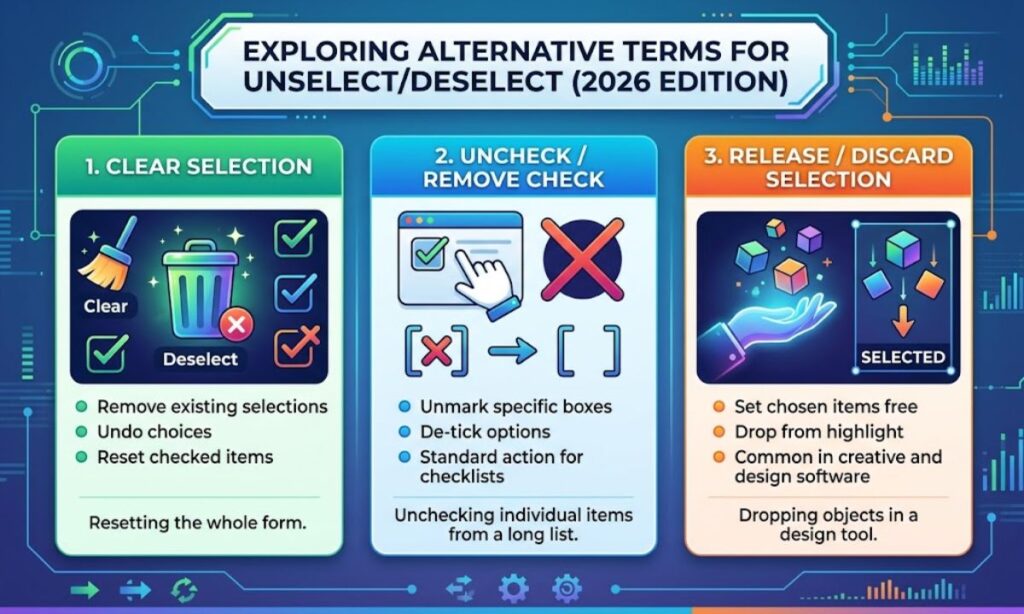
Sometimes the best answer is a different word entirely. Consider these options:
- Clear: Useful for removing all selections at once, as in “Clear selection.”
- Uncheck: Best for checkboxes specifically, as in “Uncheck the box.”
- Untick: Common in British English for the same checkbox action.
- Remove: Works when the selection is part of a list or cart.
- Dismiss: Suits notifications or highlighted elements.
- Toggle off: Good for switches and settings.
Choosing a more precise verb can reduce ambiguity. “Uncheck” tells the user exactly what to do with a checkbox, while “deselect” is broader and covers text, files, and objects. When the control is a checkbox, uncheck is often clearer than either option in the unselect vs deselect debate.
When to Use Deselect or Unselect
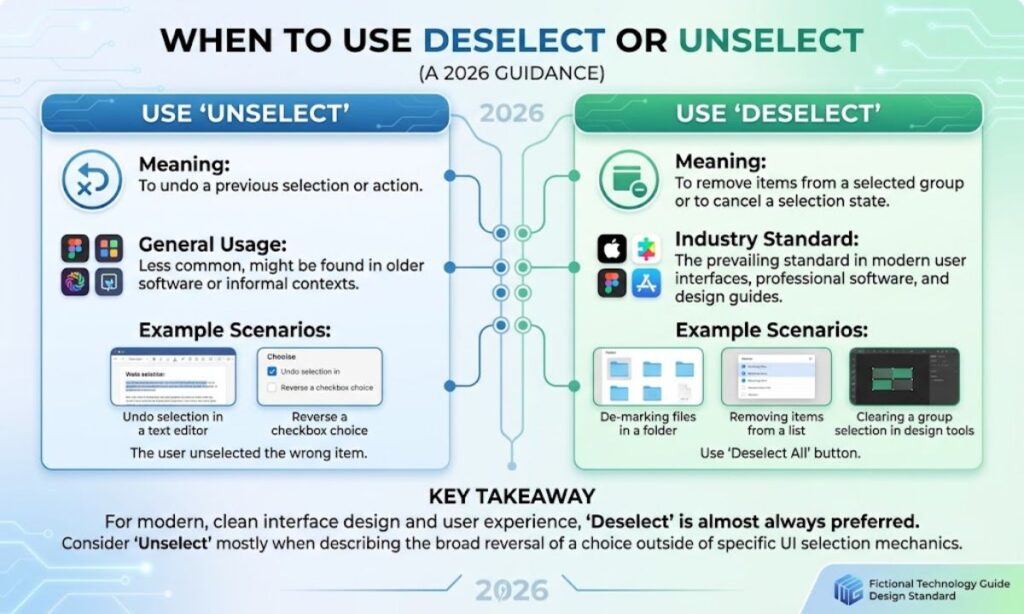
Here is a simple decision guide. Match the word to your audience, your medium, and your tone, and you will rarely go wrong with unselect vs deselect.
Always Use “Deselect” When:
- You are writing technical documentation, user manuals, or help center articles.
- You are describing menu commands, such as “Deselect All.”
- Your audience includes developers, designers, or business professionals.
- You are writing academic, legal, or formal content.
- You want to match industry conventions and avoid distracting readers.
- You need a noun form, since “deselection” is well established.
- Your content will be translated or localized, because standard terms translate more reliably.
When in doubt about unselect vs deselect, deselect is the answer. It carries no risk of sounding sloppy, and it aligns with what most readers have seen in the software they use every day. For formal work, unselect vs deselect is rarely a close call.
Use “Unselect” When:
- Your brand voice is casual, playful, or conversational.
- You are writing text messages, social posts, or chat replies.
- The product interface itself already uses “Unselect” on its buttons, and you need to stay consistent with it.
- You are quoting a user or reproducing on-screen text exactly.
- You are writing for a young or non-technical audience who naturally say unselect.
Consistency matters more than preference. If your app says “Unselect” on a button, your help article should say it too. Mixing both words in one product creates confusion, and the unselect vs deselect choice should be made once and applied everywhere.
Common Mistakes to Avoid
Even a small word choice can trip up writers. Watch for these common errors.
1. Mixing both words in one document. Switching between the two within the same article or interface looks careless. Pick one and then stay with it throughout.
2. Assuming unselect is incorrect. It is a real word, and calling it wrong is overcorrecting. It is simply less formal.
3. Using deselect for the wrong action. Deselect means to remove a selection. It does not mean to reject, delete, or uninstall. Do not write “deselect the app” when you mean “uninstall the app.”
4. Confusing deselect with disselect or deselct. Misspellings are surprisingly common. The correct spelling is d-e-s-e-l-e-c-t.
5. Ignoring the interface. If you write documentation, check the exact wording on the screen. Your text should mirror the label users see.
6. Choosing a vague verb. Sometimes “uncheck,” “clear,” or “remove” tells readers exactly what to do. Use them when they fit better than either word in the unselect vs deselect pair.
Avoiding these mistakes will keep your writing consistent, clear, and professional.
Frequently Asked Questions
Is unselect a real word?
Yes. Unselect appears in several dictionaries and is widely understood. It is generally considered informal, and deselect is the preferred standard in professional writing.
Which is more common, unselect or deselect?
Deselect is far more common, especially in software, publishing, and business contexts. Unselect appears mostly in casual speech and some app interfaces.
Do unselect and deselect mean the same thing?
Yes. Both mean to remove a choice you previously made. The difference between unselect vs deselect lies in tone and convention, not meaning.
Can I use unselect in formal writing?
It is better to avoid it. Use deselect in reports, manuals, and academic work to match reader expectations.
Should buttons say Unselect or Deselect?
Most interfaces use Deselect, as in “Deselect All.” Choose one term and use it consistently across your whole product, whatever your view on unselect vs deselect.
Conclusion
The debate over unselect vs deselect is smaller than it looks. Both words mean the same thing, and readers will understand either one. What separates them is register and convention. Deselect is the standard, professional choice, backed by dictionaries, software documentation, and decades of interface design. Unselect is a perfectly valid casual alternative that suits conversational writing and brands with a relaxed voice.
Here is the simple takeaway for 2026: default to deselect, use unselect when your tone or interface calls for it, and stay consistent throughout. When a more specific verb such as uncheck or clear fits the situation, use it. Master these habits, and you will never hesitate over unselect vs deselect again.

Liam Joseph Miller is an English language writer and content creator focused on grammar, spelling, vocabulary, and writing. He creates simple, easy-to-understand guides that help readers learn English and avoid common language mistakes. Through OkayMegazines, Liam shares practical explanations, examples, and useful language tips for students, writers, and everyday English learners.