

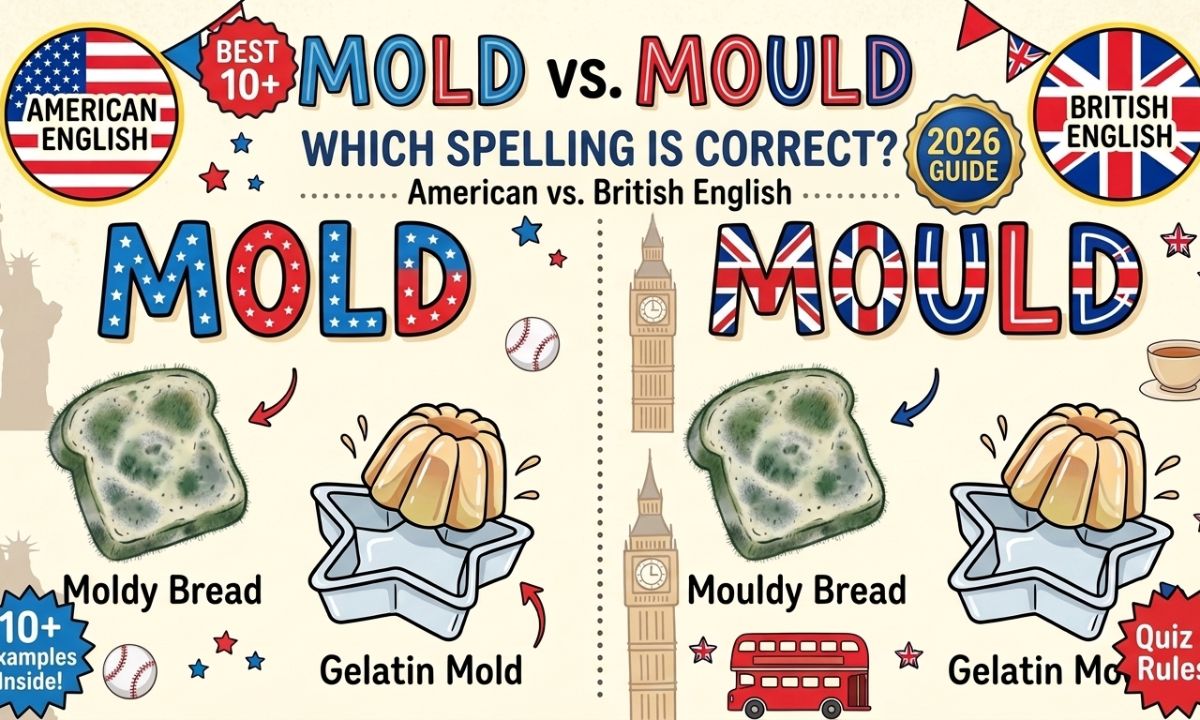
Mold vs. Mould: both spellings mean the same thing. “Mold” is the American spelling, and “mould” is the British spelling. The meaning, pronunciation, and grammar stay identical.
The difference only shows up on the page. Choose the spelling that matches your audience, then use it consistently.
This guide on mold vs. mould covers the meaning, regional usage, real examples, common mistakes, and a food safety question people often ask: can you eat moldy bread?
What Does “Mold” Mean?
“Mold” is the American English spelling of a word with several related meanings. It names a fungus, a shaping tool, and an action.
Here are the main senses:
- Fungus: a fuzzy or powdery growth on damp surfaces or food.
- Container or frame: a hollow form used to shape liquid or soft material, such as a jelly mold.
- Pattern or type: a person who fits a certain style, as in “cast in the same mold.”
- Verb: to shape or influence something.
Grammarist notes that the word works as both a noun and a verb, and that its roots trace back to the Latin word modulus.
“Mold” in Different American English Contexts
In the US, “mold” appears in many everyday settings. The spelling stays the same in each one.
| Context | Example |
| Home | Black mold in the bathroom |
| Kitchen | Mold on bread or cheese |
| Cooking | A silicone cake mold |
| Manufacturing | An injection mold for plastic parts |
| Construction | Crown molding on the ceiling |
| Idiom | “He broke the mold.” |
| Health | Mold allergy symptoms |
News outlets, US health agencies, and American dictionaries all use this form.
What Does “Mould” Mean?
“Mould” is the British English spelling of the same word. It carries the same fungus, shape, and verb meanings.
Sources comparing the two note that mold and mould are alternative spellings of one word, with mold common in American English and mould preferred in British English and Canada.
Nothing changes beyond the extra “u.” The two spellings are not two separate words.
“Mould” in Different British English Contexts
British, Australian, and New Zealand writers use “mould” in the same range of settings.
| Context | Example |
| Home | Mould on the bedroom wall |
| Kitchen | Mouldy bread in the bin |
| Cooking | A jelly mould |
| Manufacturing | A mould for casting metal |
| Construction | Crown moulding |
| Idiom | “She doesn’t fit the mould.” |
| Property | Damp and mould in rented flats |
The word is even used in the UK for compost-style soil in gardening (“leaf mould”).
Mold vs. Mould — Key Differences That Actually Matter
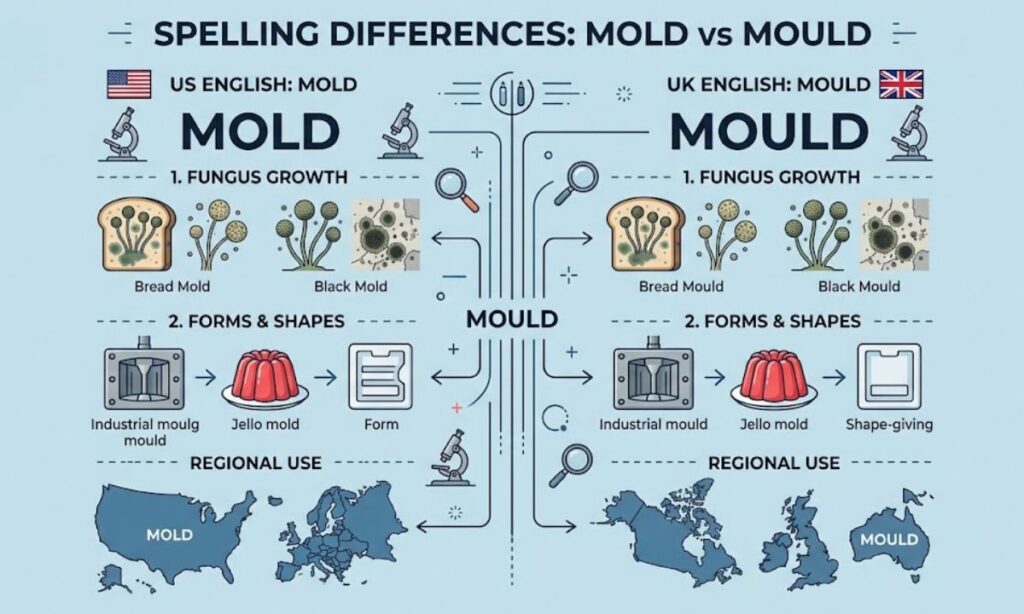
The only real difference is spelling and the audience it signals. Everything else is the same.
| Feature | Mold | Mould |
| Spelling style | American | British / Commonwealth |
| Meaning | Fungus, shape, verb | Fungus, shape, verb |
| Pronunciation | Rhymes with “gold” | Rhymes with “gold” |
| Adjective | Moldy | Mouldy |
| -ing form | Molding | Moulding |
| -ed form | Molded | Moulded |
| Used in | US | UK, Australia, NZ, often Canada |
Neither spelling is wrong. They only look different.
Regional Spelling: Mold vs Mould
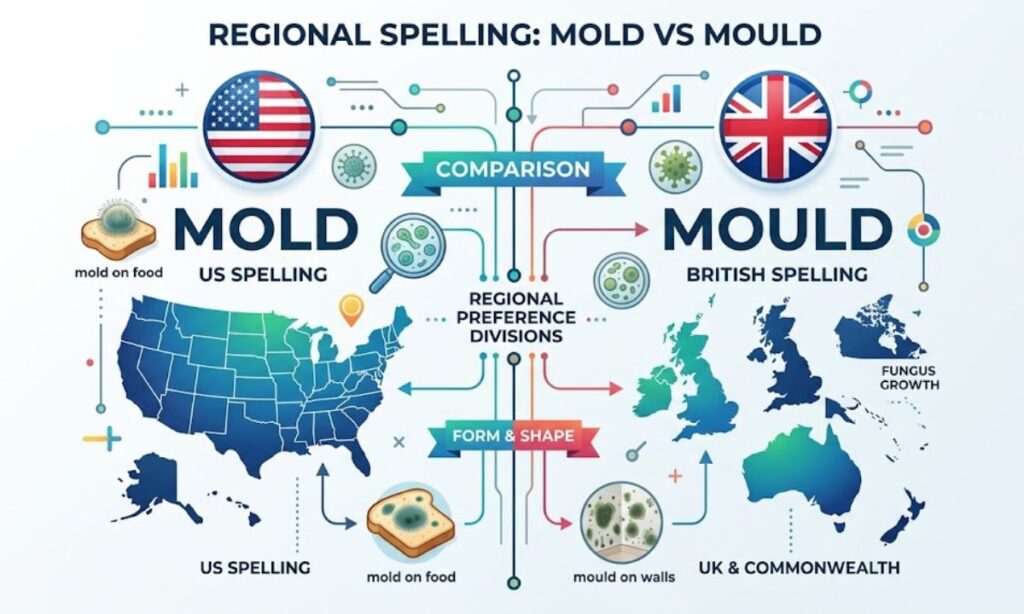
Where you live (and who you write for) decides the spelling.
- United States: mold
- United Kingdom: mould
- Australia and New Zealand: mould
- Canada: mixed, but leans toward mould
- India and much of South Asia: usually mould, following British style
Several sources report that mould is preferred in the UK, Canada, and Australia, while mold is standard in the US.
Canada is the tricky case. One Canadian site points out that Health Canada uses “mould,” while its own business uses “mold.” Canadian writers often choose based on their publication’s style guide.
For readers in Pakistan, India, and the Gulf, the British form “mould” is the safer default in formal writing.
Every Form of the Word Follows the Same Rule
The spelling difference carries into related forms like moldy/mouldy, molding/moulding, and the verb meaning to shape something.
| American | British |
| mold | mould |
| molds | moulds |
| molded | moulded |
| molding | moulding |
| moldy | mouldy |
| moldiness | mouldiness |
If you pick one spelling, apply it to every form. A page with “mold” and “mouldy” side by side looks like an error.
Mold vs Mould: American vs British English
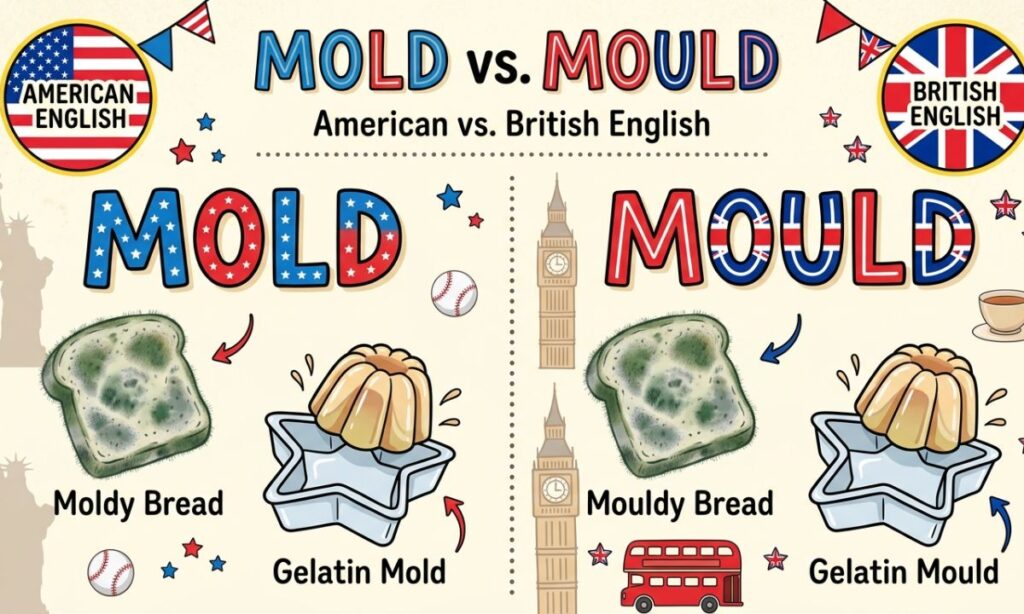
This pair belongs to a larger pattern. Many British words keep a “u” that American English drops.
Americans tend to leave out the “u” that British English places before a consonant in certain words.
| British | American |
| colour | color |
| favour | favor |
| neighbour | neighbor |
| humour | humor |
| mould | mold |
Memory trick: “Mould” has a “u” like “United Kingdom.” “Mold” is the shorter, simpler US version.
When Both Appear in the Same Document
Sometimes both spellings show up, for example in a quoted source or a brand name. Here is how to handle it:
- Pick one spelling for your own writing.
- Keep quotes exact. Do not “correct” someone else’s words.
- Keep proper names exact. A company called “Mold Busters” stays as written.
- Set your editor’s language (US or UK) so spell check stays consistent.
Side-by-Side Examples: Mold vs. Mould in Real Sentences
“Mold” in American English Writing
- “Mold grew behind the refrigerator after the leak.”
- “She poured the gelatin into a heart-shaped mold.”
- “The coach tried to mold the rookie into a leader.”
- “The old bread was moldy, so I threw it out.”
“Mould” in British English Writing
- “Mould appeared on the ceiling after the storm.”
- “He poured the chocolate into a star-shaped mould.”
- “The manager tried to mould the youngsters into a team.”
- “The mouldy bread went straight into the bin.”
Same Sentence, Two Spellings — Zero Difference in Meaning
| American | British |
| “Mold needs moisture to grow.” | “Mould needs moisture to grow.” |
| “We molded the clay by hand.” | “We moulded the clay by hand.” |
| “Check for moldy fruit.” | “Check for mouldy fruit.” |
A reader in any country understands both. Only the style changes.
Is It Bad to Eat Bread If One Slice Is Moldy?
Yes, USDA guidance says to throw away the whole loaf. Cutting off the spot is not recommended for bread.
A USDA specialist explains that bread is a soft food, so mold roots can easily travel deeper into it. You often cannot see these roots.
Here is why bread is risky:
- Hidden spread. Roots may reach slices that look clean.
- Possible bacteria. Moldy foods may also have bacteria growing along with the mold.
- Allergy risk. Moldy bread can cause breathing problems in people with mold allergies.
- Spores in the air. Do not sniff it to check.
Some food scientists consider a tiny spot lower risk. One food safety site notes that experts at Rutgers and North Carolina State discussed this and judged slightly moldy bread as not very risky, while calling the USDA’s advice conservative. Even so, the official guidance is the safest rule to follow, especially for children, older adults, and anyone with allergies.
Rule of thumb: if you see mold on bread, throw out the loaf.
USDA Guidelines for Mold on Foods
The USDA’s general rule: soft or porous foods with mold should be discarded, while some firm foods can be saved after careful trimming.
The USDA’s Food Safety and Inspection Service says that for bread, the advice is to discard it.
| Food Type | USDA-Style Advice |
| Bread and baked goods | Discard |
| Soft fruits (strawberries, peaches, tomatoes) | Discard |
| Jams and jellies | Discard |
| Lunch meats | Discard |
| Firm vegetables (carrots, bell peppers, cabbage) | Cut off at least 1 inch around the spot |
| Hard cheese | Cut off at least 1 inch around the spot |
| Hard salami and dry-cured ham | Scrub the surface mold |
For firm foods, the guidance is to cut off at least an inch around and below a small mold spot, keeping the knife out of the mold itself.
Extra safety tips:
- Check neighbors. Look at foods stored near the moldy item.
- Do not sniff. Spores can trigger allergies.
- Clean the fridge. Mold spores can build up in your fridge, dishcloths, and utensils.
- Bag it. Seal moldy food in a bag before binning it.
- Freeze bread if you will not finish it in time.
This is general food safety information. For a specific health concern, talk to a doctor.
Common Mistakes Writers Make with “Mold” and “Mould”
The biggest mistake is mixing both spellings in one piece. Here are the others to avoid:
- Using “mold” for fungus and “mould” for shaping. Some people do this, but it is not a rule. Forum users even report opposite habits in different countries.
- Switching forms mid-article. “Mould” in the intro and “moldy” later looks careless.
- Changing quotes or names. Leave brand names and quotations exactly as published.
- Ignoring the audience. A UK clinic website should say “mould.” A US hardware store should say “mold.”
- Assuming one is a typo. Both are correct.
- Forgetting related forms. Check “molding/moulding” and “molded/moulded” too.
- Trusting the wrong spell-check language. Set your document to US or UK English before editing.
Frequently Asked Questions
Is it mold or mould?
Both are correct. “Mold” is American English, and “mould” is British English.
Do mold and mould mean the same thing?
Yes. They are spelling variants of the same word, with identical meanings.
Which spelling is used in the UK?
The UK uses “mould,” along with “mouldy” and “moulding.”
Which spelling is used in the US?
The US uses “mold,” along with “moldy” and “molding.”
Is mould used in Canada?
Often, yes, but Canadian usage is mixed. Many Canadian sources use “mould,” while some businesses use “mold.”
Which spelling should I use for a global audience?
Follow your main audience. If it is mixed, choose one spelling and keep it consistent throughout.
Is the pronunciation different?
No. Both are pronounced the same way, rhyming with “gold.”
Is moldy bread safe to eat?
No. USDA guidance says to discard the whole loaf, because mold roots can spread unseen.
Can you cut mold off hard cheese?
Usually yes. Cut at least 1 inch around and below the spot, keeping the knife out of the mold.
Conclusion
Mold vs. mould is a spelling choice, not a meaning difference. Use “mold” for American readers and “mould” for British, Australian, and most Commonwealth audiences.
Keep your choice consistent across every form, including moldy/mouldy and molding/moulding. Leave quotes and brand names untouched.
On the food side, remember the practical rule: discard moldy bread, and trim only firm foods that the USDA says are safe to trim. Whichever way you spell it, safe handling matters more than the extra “u.”

Liam Joseph Miller is an English language writer and content creator focused on grammar, spelling, vocabulary, and writing. He creates simple, easy-to-understand guides that help readers learn English and avoid common language mistakes. Through OkayMegazines, Liam shares practical explanations, examples, and useful language tips for students, writers, and everyday English learners.