


“Envolved” is a common misspelling, and the correct spelling is “involved.” The word “envolved” doesn’t exist in standard English. People usually make this mistake because the word sounds like it begins with “en-,” similar to words such as “envelop” or “envision.”
The confusion is understandable, since English spelling doesn’t always match pronunciation, but the correct form always begins with “in-“: involve, involved, involving, involvement.”Involved” is the past tense and past participle of the verb “involve,” which means to include something as a necessary part, to engage someone in an activity, or to affect or concern someone directly. For example, you might say, “She is deeply involved in the community project,” or “Several factors were involved in the decision.”
Quick answer
The correct spelling is “involved.” “Envolved” is a common misspelling and isn’t a real English word. People confuse it because “en-” appears in similar-sounding words like “envelop” and “envision,” but “involve” always starts with “in-.”
“Involved” means included in something, engaged in an activity, or directly affected by it. It can also mean complicated. Example: “She is involved in the project.” Remember the pattern: involved, include, inclusion, starting with “in-.”
What Does Involved Mean?

“Involved” has two main jobs in English. It can be the past tense of the verb involve, or it can be an adjective.
Here are the core meanings:
- Taking part in something: She is involved in the school project.
- Connected to or affected by something: Three cars were involved in the accident.
- Complicated: The instructions were long and involved.
- In a relationship: He is involved with someone at work.
The word comes from the Latin involvere, which means “to roll into.” That image of being wrapped up in something still fits today.
Related Word Forms: Involve
“Involved” belongs to a family of words. Knowing them helps you pick the right form every time.Notice that every form starts with inv-. None of them starts with “env-.”
Involved in Different Contexts
| Context | Meaning | Example |
| Personal relationships | Emotionally or romantically connected | “He is involved with someone from work.” |
| Family and caring roles | Taking an active part in someone’s life | “She’s very involved in her children’s education.” |
| Work and projects | Participating in or responsible for a task | “Three departments were involved in the launch.” |
| Legal and news | Connected to an event, case, or incident (doesn’t imply guilt) | “Two vehicles were involved in the accident.” |
| Community and activities | Actively participating | “Students are encouraged to get involved in clubs.” |
| Complexity | Complicated or detailed | “It was a long and involved explanation.” |
| After a noun | Acts as an adjective placed after the word it describes | “All the people involved signed the agreement.” |
At Work
It usually means taking part or being responsible.
- “Who is involved in this project?”
- “I was not involved in that decision.”
In Relationships
It can mean a romantic connection, often with “with.”
- “They have been involved for two years.”
In News and Legal Writing
It often means connected to an event or case.
- “Police are questioning the people involved.”
In School and Community Life
It points to active participation.
- “Students who stay involved tend to enjoy school more.”
In Health Writing
It describes parts of the body that are affected.
- “The infection involved the lungs.”
What Does Envolved Mean?
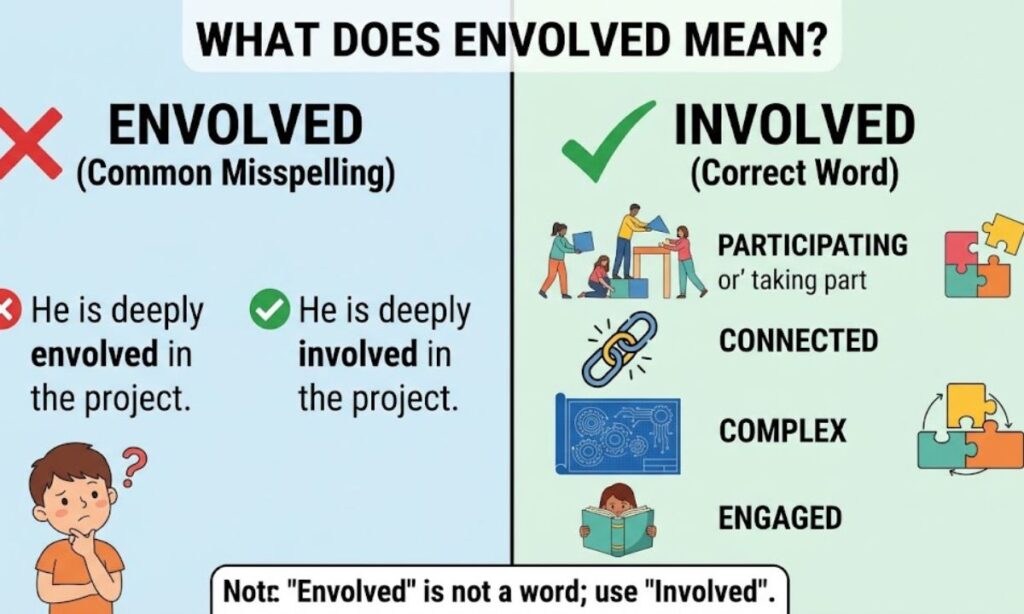
“Envolved” has no meaning in standard English. You will not find it in major dictionaries as a valid word.
It is simply a misspelling of “involved.” Spell checkers usually flag it with a red line.
Why People Write “Envolved”
Misspellings usually have a reason. Here are the most common ones for this word.
- Sound confusion: In fast speech, the first syllable can sound like “en” or “in.” Many people spell what they hear.
- Look-alike words: English has many “en-” words such as enroll, envelop, and engage. The brain often borrows that pattern.
- Other languages: In Portuguese, the word for “involved” is envolvido. In Spanish, a similar word is envuelto. Speakers of these languages may carry the “env-” spelling into English.
- Autopilot typing: On a phone, a quick tap or autocorrect slip can produce the error.
Envolved or Involved Comparison Table
| Feature | Involved | Envolved |
| Correct spelling? | Yes | No |
| Found in dictionaries? | Yes | No |
| Part of speech | Verb (past) and adjective | None |
| Meaning | Participating, connected, or complicated | No standard meaning |
| Safe for essays and emails? | Yes | No |
| Root word | Involve | None |
| Origin | Latin involvere | Spelling error |
Common Uses of “Involved” — With Examples
Let’s look at the main ways “involved” works in a sentence.
Involved as a Verb (Past Tense)
Here, “involved” is the past form of “involved”. It describes something that included, required, or affected something else.
Examples:
- The renovation involved replacing the entire roof.
- The study involved over 200 volunteers.
- Her job involved a lot of travel.
Involved as an Adjective — Participation
Here, “involved” describes someone who takes part, or someone connected to an event. It often comes with “in” or “with.”
Examples:
- Parents should stay involved in their children’s education.
- Everyone involved in the event received a thank-you note.
- He is deeply involved with the local charity.
Common phrases:
- get involved
- stay involved
- actively involved
- emotionally involved
- directly involved
Involved as an Adjective — Complexity
Here, “involved” means complicated or having many steps.
Examples:
- The recipe is quite involved, so start early.
- It was a long and involved explanation.
- The visa process can be very involved.
Common Mistakes to Avoid
Even people who know the right spelling slip up. Watch for these mistakes.
- Writing “envolved” instead of “involved.”
- Wrong: She was envolved in the project.
- Right: She was involved in the project.
- Writing “envolvement.”
- Wrong: His envolvement was clear.
- Right: His involvement was clear.
- Mixing up “involved” and “envelope.”
- Envelop means to wrap or surround, as in “Fog began to envelop the town.”
- Involved means taking part or being complicated.
- Using the wrong preposition.
- “Involved in” is used for activities and events.
- “Involved with” is used for people and organizations.
- Trusting autocorrect blindly.
Always reread your final text, especially emails and job applications.
Frequently Asked Questions
Is it Envolved or involved?
The correct spelling is involved. “Envolved” is a misspelling and is not a real English word.
What does involved mean?
“Involved” means taking part in something, being connected to it, or being complicated. It is both a past-tense verb and an adjective.
Is “envolved” a word?
No. It does not appear in standard English dictionaries and should be corrected to “involved.”
How do you spell involved?
It is spelled I-N-V-O-L-V-E-D. It begins with “in,” just like “inside” or “include.”
Why do people spell it “envolved”?
It often comes from how the word sounds, from “en-” words like enroll, or from languages such as Portuguese where a similar word uses “env-.”
What is the difference between involved and involve?
“Involve” is the base verb, and “involved” is its past tense or adjective form. Example: “The job will involve travel” versus “The job involved travel.”
Can involved mean complicated?
Yes. In phrases like “an involved process,” it means complex or having many steps.
Should I say involved in or involved with?
Use “involved in” for events and activities, and “involved with” for people, groups, or relationships. Example: “involved in a project,” “involved with a team.”
What is the noun form of involved?
The noun is involvement. Example: “Her involvement in the club grew over time.”
Conclusion
“Envolved” is simply a misspelling, and the correct word is always “involved.” Remembering that it begins with “in-“, like “include” and “inclusion,” is the easiest way to avoid the mistake.
As the contexts above show, “involved” is a flexible word. It can describe emotional connections, participation in work or community activities, connection to an event or case, or something complicated. It can also follow a noun, as in “the people involved.” Knowing these uses will help you write clearly and confidently, whether in everyday messages or formal documents.

Liam Joseph Miller is an English language writer and content creator focused on grammar, spelling, vocabulary, and writing. He creates simple, easy-to-understand guides that help readers learn English and avoid common language mistakes. Through OkayMegazines, Liam shares practical explanations, examples, and useful language tips for students, writers, and everyday English learners.