

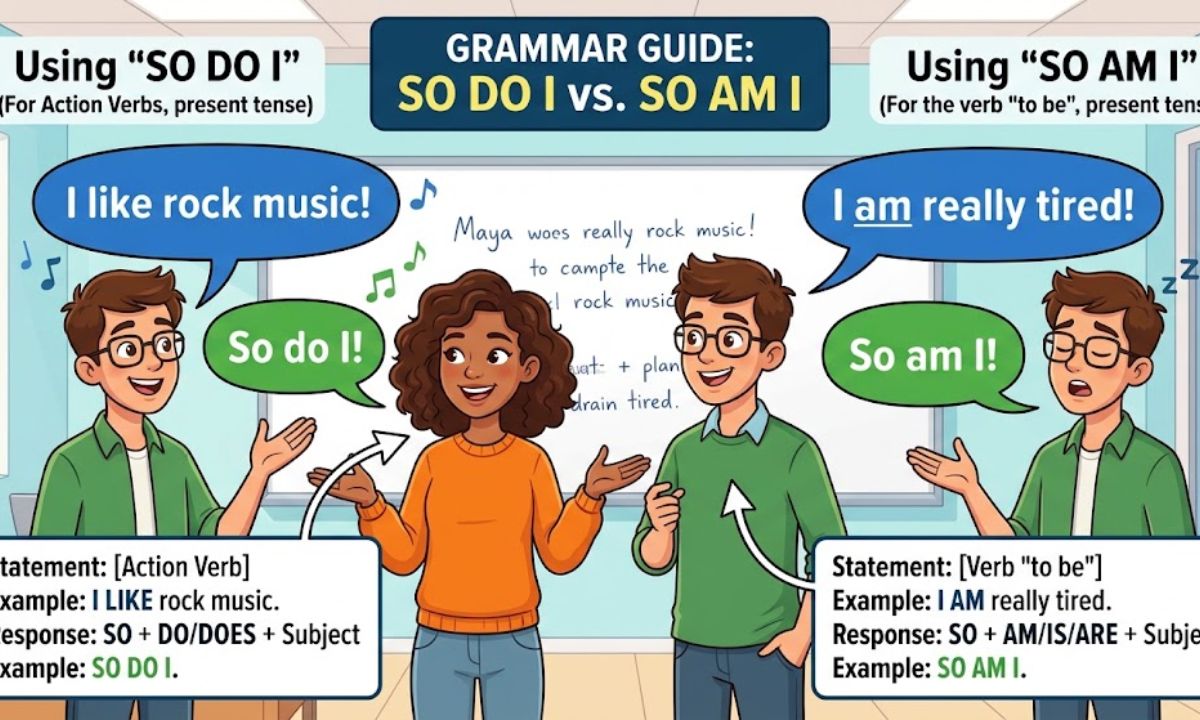
You say, “I’m tired,” and your friend replies, “So do I.” Something sounds off, but you can’t say why.
Learners mix up so do I vs so am I all the time. The good news is that there is one simple rule behind both. This guide explains the difference, gives clear examples, and includes a short worksheet so you can practise.
What Is the Difference Between “So Am I” and “So Do I”?
Both phrases mean “me too.” Both agree with a positive statement. The only difference is the helping verb (the auxiliary) that follows “so.”
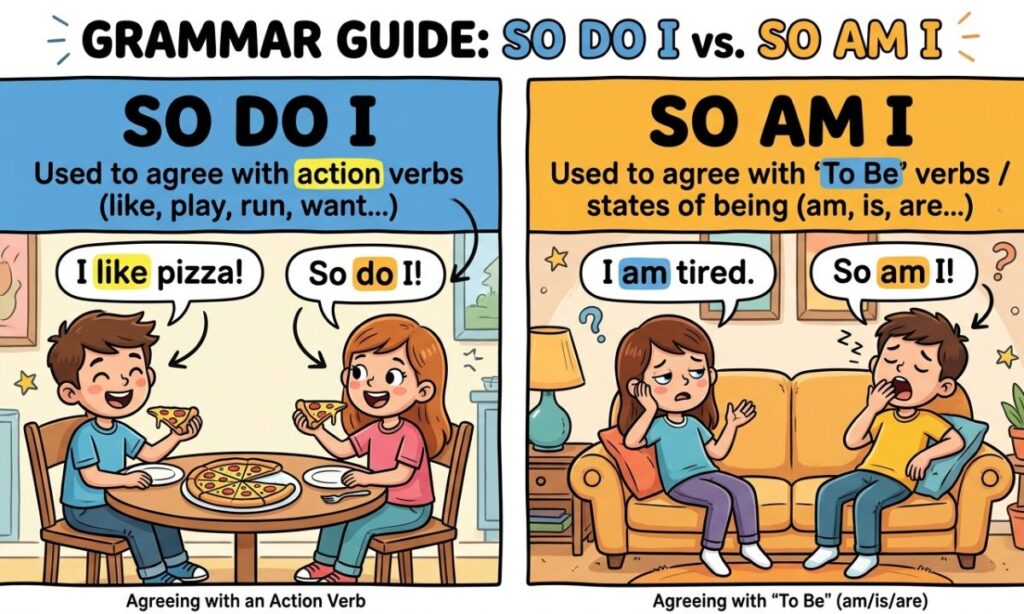
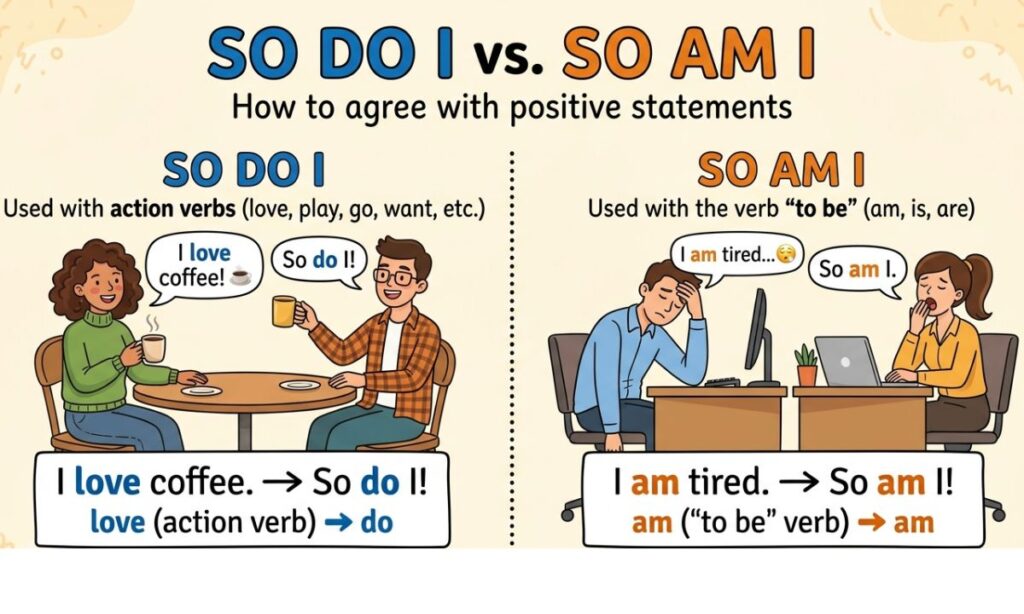
- So am I agrees with a sentence that uses the verb be (am, is, are).
- So do I agrees with a sentence that uses a regular action verb in the present simple.
Here is the quick version:
- “I’m hungry.” → So am I.
- “I love pizza.” → So do I.
The first sentence has am, so you answer with am. The second has the action verb love, so you answer with do.
So Do I vs So Am I Grammar
Both phrases follow the same pattern:
So + auxiliary verb + subject
The word order is flipped. We say “So do I,” never “So I do” (that means something different). Grammar teachers call this inversion. The auxiliary comes before the subject, just like in a question.
Three points to remember:
- “So” shows you agree with a positive statement.
- The auxiliary must match the verb in the first sentence.
- The subject goes last: So do I, So does she, So are they.
This structure is also called an agreement response or an additive response. It shows that the same idea applies to you.
So Do I vs So Am I Reference Table
Use this table as a quick check:
| Original sentence | Verb type | Correct reply |
| I’m tired. | Be (am) | So am I. |
| She is late. | Be (is) | So is he. |
| We are ready. | Be (are) | So are they. |
| I like tea. | Action verb (present) | So do I. |
| He plays guitar. | Action verb (third person) | So does she. |
| I went home. | Action verb (past) | So did I. |
| I was upset. | Be (past) | So was I. |
| I have finished. | Perfect | So have I. |
| I can swim. | Modal | So can I. |
| I will come. | Future modal | So will I. |
Save this table. It answers most of your questions about so do I vs so am I.
When to Use “So Am I”
Use “so am I” when the first speaker uses am, is, or are. This includes sentences with:
- Be plus an adjective: “I’m excited.”
- Be plus a noun: “I’m a teacher.”
- Be plus a place: “I’m at home.”
- The present continuous: “I’m studying.”
The speaker’s verb is a form of be. Your reply must be a form of be too.
Conversation Examples
Example 1
- A: “I’m really nervous about the exam.”
- B: “So am I.”
Example 2
- A: “I’m from Lahore.”
- B: “So am I!”
Example 3
- A: “I’m working late tonight.”
- B: “So am I. Let’s grab coffee later.”
Example 4
- A: “She is very happy with her results.”
- B: “So is her brother.”
Notice that the subject changes the verb form. After “I,” use am. After “he,” “she,” or “it,” use is. After “we,” “you,” or “they,” use are.
When to Use “So Do I”
Use “so do I” when the first speaker uses a main action verb in the present simple. These are verbs like like, want, need, live, work, love, and hate.
The verb is not a form of be, so you bring in do as the helper. Use do for I, you, we, and they. Use does for he, she, and it.
Conversation Examples
Example 1
- A: “I love horror movies.”
- B: “So do I.”
Example 2
- A: “I need a holiday.”
- B: “So do I!”
Example 3
- A: “My sister wakes up at five every day.”
- B: “So does mine.”
Example 4
- A: “They live near the beach.”
- B: “So do we.”
The Verb Matching Rule: The Core Principle
Here is the one rule behind so do I vs so am I:
Match the auxiliary verb from the first sentence.
Follow these three steps:
- Find the verb in the first sentence.
- Ask: is it be, or is it an action verb?
- Use the same helper in your reply.
The quick test: Is there an action verb?
- Yes → use do / does / did.
- No, it’s be → use am / is / are / was / were.
“I’m tired” has no action verb, only am. So you say “So am I.”
“I enjoy reading” has the action verb enjoy. So you say “So do I.”
Matching the tense matters too. Present gets present, past gets past:
- “I went to school.” → “So did I.”
- “I was late.” → “So was I.”
So Do I vs So Am I Examples
Here are more sentences, grouped for easy review.
Using “So Am I”
- “I’m thirsty.” → So am I.
- “I’m not a morning person, but I’m getting up early tomorrow.” → So am I.
- “I’m interested in photography.” → So am I.
- “I’m learning Spanish.” → So am I.
Using “So Do I”
- “I walk to work.” → So do I.
- “I enjoy cooking on weekends.” → So do I.
- “I want to travel more.” → So do I.
- “I speak two languages.” → So do I.
Mixed Subjects
- “Maria drinks green tea.” → So does Ali.
- “My parents are retired.” → So are mine.
- “We work from home.” → So do they.
Beyond “Am” and “Do”: Other Agreement Forms
“Am” and “do” are only two options. The same pattern works with many other auxiliaries:
| Original sentence | Reply |
| I did my homework. | So did I. |
| She was at the party. | So was I. |
| They were tired. | So were we. |
| I have seen that film. | So have I. |
| He has finished. | So has she. |
| I can cook. | So can I. |
| I will help. | So will I. |
| She would love that. | So would I. |
| I should rest. | So should I. |
| I must go. | So must I. |
The rule never changes. Take the helper from the first sentence and put it right after “so.”
You can also use casual alternatives:
- Me too. (works for any positive statement)
- I do too. / I am too.
“Me too” is the easiest choice in casual chat. “So do I” and “So am I” sound a little more polished.
Negative Agreement: “Neither Am I” and “Neither Do I”
What if the first speaker says something negative? You swap “so” for neither (or nor). The rule stays the same: match the auxiliary.
| Negative statement | Reply |
| I’m not ready. | Neither am I. |
| I don’t like spicy food. | Neither do I. |
| She doesn’t drive. | Neither does he. |
| I didn’t sleep well. | Neither did I. |
| I haven’t eaten yet. | Neither have I. |
| I can’t swim. | Neither can I. |
Two things to remember:
- Don’t add “not.” “Neither” already carries the negative meaning. “Neither don’t I” is wrong.
- Keep the inversion. Say “Neither do I,” not “Neither I do.”
You can also say “Me neither” or “I don’t either.”
So Do I vs So Am I Worksheet

Try these ten items. Fill in the blank with the correct reply. Answers follow below.
- “I’m very busy this week.” → So ____ I.
- “I drink coffee every morning.” → So ____ I.
- “She is a great singer.” → So ____ her sister.
- “He plays football on Sundays.” → So ____ my brother.
- “I was afraid of dogs as a child.” → So ____ I.
- “I went to the market yesterday.” → So ____ I.
- “I’m not hungry.” → Neither ____ I.
- “I don’t watch much TV.” → Neither ____ I.
- “We have finished the project.” → So ____ they.
- “I can speak French.” → So ____ I.
Answers:
- am
- do
- is
- does
- was
- did
- am
- do
- have
- can
If you scored 8 or more, you have the so do I vs so am I rule down. If not, reread the reference table and try again tomorrow.
Common Mistakes With “So Do I” vs “So am I”
Even advanced learners slip up. Watch for these errors.
Mistake 1: Using “do” after “be”
- ❌ “I’m tired.” → “So do I.”
- ✅ “I’m tired.” → “So am I.”
Mistake 2: Using “am” after an action verb
- ❌ “I love music.” → “So am I.”
- ✅ “I love music.” → “So do I.”
Mistake 3: Forgetting to invert the word order
- ❌ “So I am.”
- ✅ “So am I.”
Note: “So I am” is not wrong in every case. It confirms a fact, as in “You’re late.” “So I am.” It does not mean “me too.”
Mistake 4: Mixing tenses
- ❌ “I went home early.” → “So do I.”
- ✅ “I went home early.” → “So did I.”
Mistake 5: Using “so” with a negative sentence
- ❌ “I don’t like fish.” → “So do I.”
- ✅ “I don’t like fish.” → “Neither do I.”
Mistake 6: Wrong form for the new subject
- ❌ “He likes tea.” → “So do she.”
- ✅ “He likes tea.” → “So does she.”
Quick fix: Before you reply, say the first sentence’s verb out loud. Then reuse its helper.
Frequently Asked Questions
What is the difference between “so do I” vs “so am I”?
“So am I” answers sentences with be (am, is, are). “So do I” answers sentences with an action verb in the present simple.
Is “so do I” correct English?
Yes, it is correct and common. It means “I also do” and is used after positive action-verb sentences.
Can I say “so I do” instead of “so do I”?
Not for agreement. “So I do” confirms a fact, while “so do I” means “me too.”
How do I know when to use “so am I”?
Look at the first sentence. If it has am, is, or are, reply with “so am I” (or is/are for other subjects).
What is the opposite of “so do I”?
The opposite is “neither do I,” used after negative sentences like “I don’t like fish.”
Is “me too” the same as “so do I”?
Yes, both mean you share the same experience. “Me too” is more casual and works with any positive verb.
Can “so” be used with past tense?
Yes. Use “so did I” for past action verbs and “so was I” or “so were we” for past be.
Do I use “so do I” or “so does I”?
Always “so do I.” “Does” is only for he, she, and it.
Conclusion
The so do I vs so am I question comes down to one habit: match the helping verb. If the first sentence uses be, reply with a form of be. If it uses an action verb, reply with do, does, or did. The same pattern works for have, can, will, and every other auxiliary.

Liam Joseph Miller is an English language writer and content creator focused on grammar, spelling, vocabulary, and writing. He creates simple, easy-to-understand guides that help readers learn English and avoid common language mistakes. Through OkayMegazines, Liam shares practical explanations, examples, and useful language tips for students, writers, and everyday English learners.