

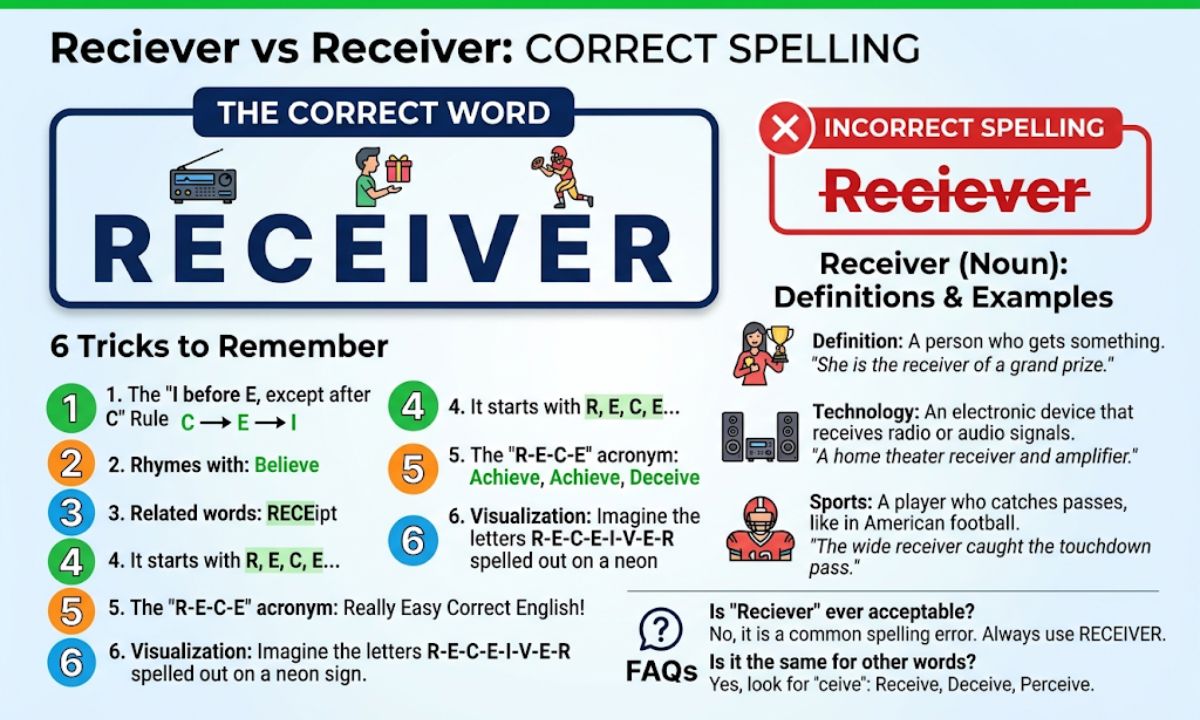
Quick answer:
The correct spelling is receiver. “Reciever” is always a misspelling. Remember the rule “i before e, except after c.” Because the letter before the “ei” is a c, the e comes first.You have probably typed this word, stopped, and wondered if it looked wrong.
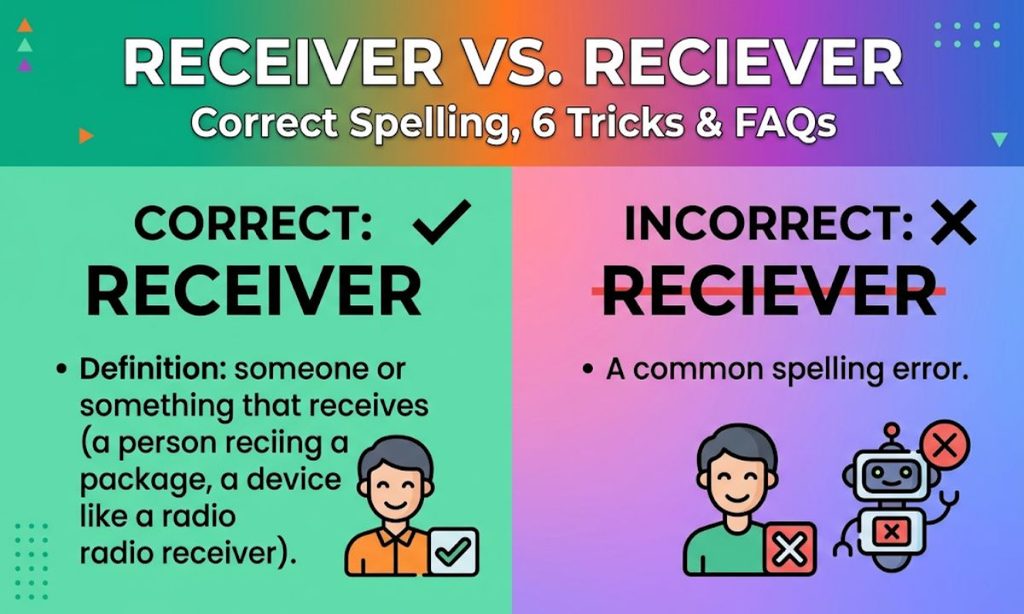
Reciever vs Receiver
Here is the whole difference in one table.
| Spelling | Correct? | Why |
| Receiver | ✅ Yes | Follows the “e before i after c” rule |
| Reciever | ❌ No | Breaks the rule and is not a real English word |
There is no regional split here. British, American, Australian and Canadian English all use “receiver.” Unlike “color” and “colour,” this is not a style choice. One version is right, and the other is a typo.
What Does “Receiver” Mean?
A receiver is a person or thing that gets, accepts or takes in something. The word comes from the verb “receive,” which means to be given, sent or handed something.
The “-er” ending turns the verb into a noun that names the one doing the action. A receiver is simply someone or something that receives.
Examples:
- The receiver of the package signed for it at the door.
- Please hand the receiver back to the caller.
- The team’s best receiver caught the ball in the end zone.
Receiver Correct Spelling
Spelled out letter by letter, the word is R-E-C-E-I-V-E-R.
Look at the middle section: c-e-i-v. The “e” comes before the “i,” and that is the part people flip by mistake.
Here are the related forms, all spelled the same way:
- Receive (verb)
- Received (past tense)
- Receiving (present participle)
- Receivers (plural)
- Unreceived (adjective)
If you can spell “receive,” you can spell every other word in the family. Just add the ending.
“Receiver” in Different Writing Contexts
The spelling never changes, but the setting does. Here is how it appears in common types of writing.
Professional emails. A typo in a work message can make you look careless. Write “the receiver of the invoice” or, even better, “the recipient.”
Academic writing. Essays and reports often use “receiver” in communication theory, where the sender and receiver exchange a message.
Technical writing. Manuals refer to radio receivers, GPS receivers and signal receivers.
Sports commentary. In American football, “wide receiver” is a standard position name.
Legal and business documents. A court can appoint a receiver to manage a company’s assets during financial trouble.
In every one of these contexts, “reciever” would count as an error. Spellcheck usually flags it, but not always, especially in headings, product names or text pasted into forms.
Why People Misspell It as “Reciever”
Misspelling this word is extremely common, and there are real reasons for it.
- The letters sound alike. The “ee” sound in “receiver” can be written “ie” or “ei,” so your ear can’t settle it.
- Typing speed. Fingers often type “ie” faster than “ei,” which is a natural pattern in English.
- Visual familiarity. Words like “believe,” “relief” and “piece” use “ie.” After seeing them so often, “ie” looks normal.
- Rule confusion. Many people remember only half of the spelling rhyme.
- Autopilot habits. Once you misspell a word a few times, the wrong version can start to look right.
Even technical communities run into this. Forum users who write about audio gear often complain about how many posts say “reciever” when they mean the home theater device.
Where the Confusion Comes From
The root problem is that English spelling is inconsistent. The language borrowed words from French, Latin and German over many centuries, and each language brought its own spelling patterns.
“Receive” came into English through Old French and traces back to Latin recipere. The “ei” spelling after “c” reflects that history, but it does not match the way most “ee” words are spelled.
The “i before e” rhyme was created to bring order to this mess. It works well for the most common words, but it has exceptions, which makes some people distrust it altogether.
Words that follow the full rule:
| Letter pattern | Examples |
| i before e (no c before it) | believe, friend, field, piece, achieve |
| e before i (after c) | receive, receiver, ceiling, deceive, perceive |
Words that break the rule:
- weird
- seize
- either and neither
- protein
- caffeine
- species and science
The exceptions are real, but “receiver” is not one of them. It follows the rule perfectly.
Receiver Noun
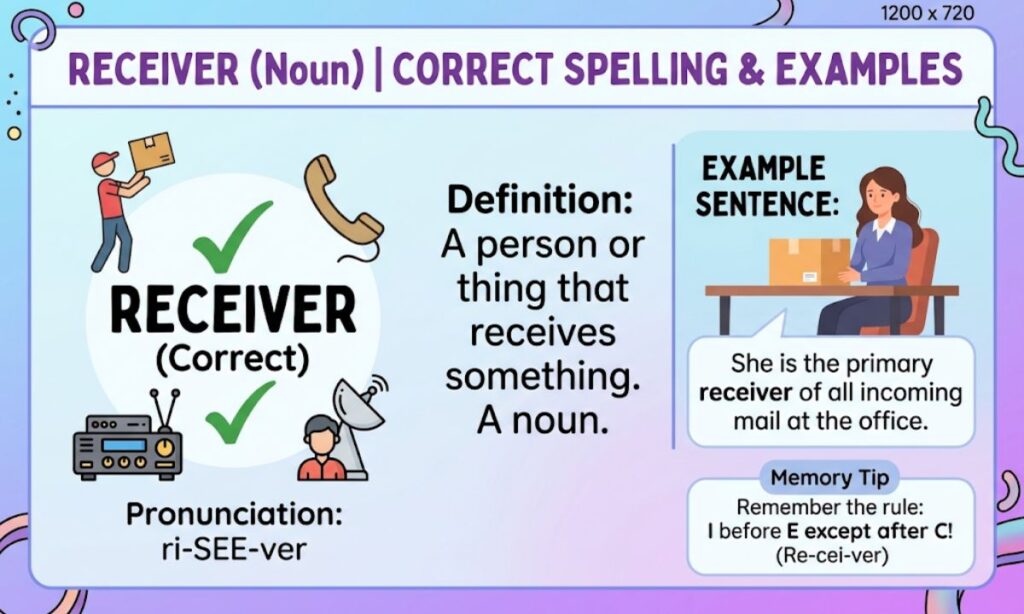
Grammatically, “receiver” is a countable noun. Its plural is “receivers.” It can be a person, a device or a role.
Pronunciation: /rɪˈsiːvər/ (rih-SEE-ver)
Three quick grammar notes:
- It is usually preceded by an article or adjective: a receiver, the new receiver.
- It often takes “of”: the receiver of the message.
- It can be part of a compound noun: radio receiver, wide receiver, phone receiver.
Example sentences:
- The receiver of the letter never wrote back.
- She picked up the receiver and dialed.
- Our new AV receiver supports Dolby Atmos.
Common Uses of Receiver
The word has several meanings, depending on the field. Here are the most common ones.
1. A person who receives something. Anyone who gets a gift, message or delivery is a receiver.
2. A telephone part. The handset you hold to your ear is called the receiver.
3. An electronic device. Radio, TV, satellite and GPS systems all use receivers to pick up signals. A home audio receiver also powers speakers and connects media sources.
4. A football position. A wide receiver catches passes from the quarterback.
5. A tennis role. The player who returns the serve is the receiver.
6. A legal officer. A court-appointed receiver takes charge of property or a business during a dispute or bankruptcy.
7. A medical term. A person who gets a donated organ is sometimes called an organ receiver, though “recipient” is more common.
8. A part of a firearm. The receiver is the main housing that holds the working parts.
| Field | Meaning of “receiver” |
| Everyday use | Person who gets something |
| Telephony | Handset |
| Electronics | Signal-receiving device |
| American football | Pass-catching player |
| Tennis | Player returning the serve |
| Law | Officer who manages assets |
Synonyms, Antonyms and Related Phrases
Choosing a synonym can help you write more clearly and avoid repeating the word.
Synonyms
- Recipient
- Addressee
- Beneficiary
- Collector
- Acceptor
- Handset (for phones)
- Catcher (in sports)
Antonyms
- Sender
- Giver
- Donor
- Transmitter
- Issuer
Related phrases
- Receiver of stolen goods
- Wide receiver
- Radio receiver
- Telephone receiver
- Receiver in bankruptcy
- Receiver and sender
Related words from the same family: reception, receipt, receptive, receptacle, receptionist. All of these keep the “cep” or “ceip” pattern after the “c,” so be careful with them too.
Memory Tip
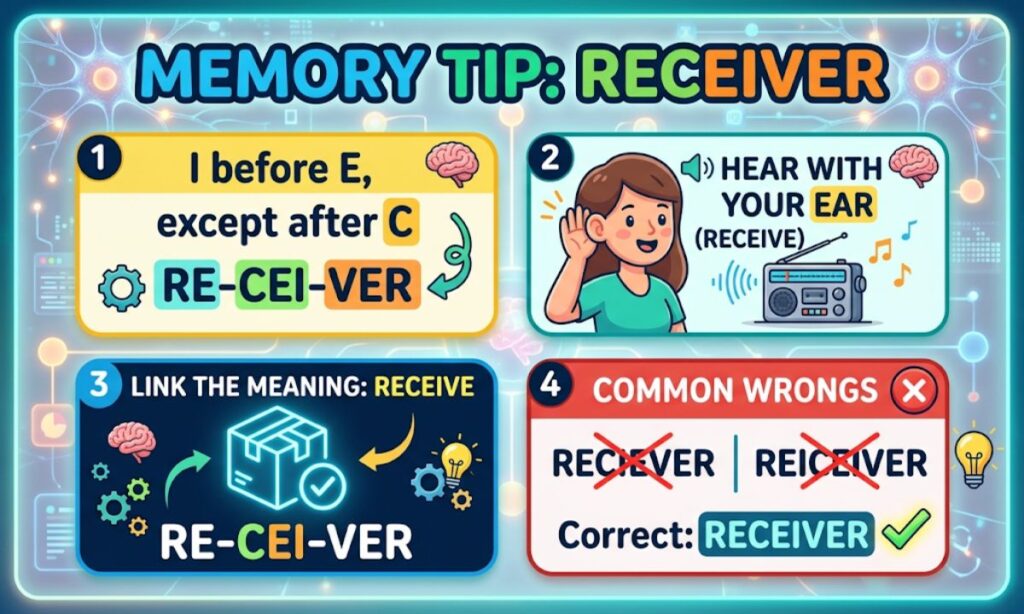
You don’t need to be a spelling expert to get this right. Try one of these tricks.
1. Use the classic rhyme.
“I before E, except after C.” Since “receiver” has a C right before the vowels, the E goes first.
2. Rhyme it with “deceiver.”
Both words end in the same pattern, and both follow the same rule. If you can spell “deceive,” you can spell “receive.”
3. Spot the “CEI.”
Think of the letters C-E-I as a short code. Picture them inside the word: re-cei-ver.
4. Use a silly sentence.
“Never believe a lie, but always receive a gift.” The first word uses “ie,” and the second uses “ei.”
5. Say it out loud.
Pronounce the word slowly: “re-SEE-ver.” Then write the letters in the order the rule requires.
6. Type it correctly three times.
Muscle memory works. Type “receiver” correctly a few times, and your fingers will start to remember.
A quick self-test: which of these is right?
- a) The reciever answered the call.
- b) The receiver answered the call.
The answer is b. Check how you did, and if you chose a, just read the rule again.
Frequently Asked Questions
Is it “reciever” or “receiver”?
The correct spelling is “receiver.” “Reciever” is a common misspelling and is never correct.
Is “reciever” ever correct?
No. It is not an accepted spelling in any English dialect.
What is the difference between reciever and receiver?
There is no difference in meaning. “Reciever” is simply a typo of “receiver.”
How do you spell receiver?
Spell it R-E-C-E-I-V-E-R, with “e” before “i” because the preceding letter is “c.”
Is receiver a noun or a verb?
It is a noun. The related verb is “receive.”
What is the best way to remember the spelling?
Use “i before e, except after c,” and remember that “receiver” rhymes in spelling with “deceiver.”
Why do so many people misspell receiver?
The “ee” sound can be written two ways, and words like “believe” make “ie” look familiar.
What is a wide receiver?
A wide receiver is an American football player whose main job is to catch passes.
Is it receiver or reciever in British English?
It is “receiver” in British English, just as it is in American English.
What is the plural of receiver?
The plural is “receivers.”
Conclusion
The debate over reciever vs receiver has a simple answer: receiver is the only correct spelling. “Reciever” is a common mistake caused by similar sounds, fast typing and the confusing “i before e” rule.
To recap:
- Write receiver, with “ei” after the “c.”
- Use the rule “i before e, except after c.”
- Link it to “deceiver” for a quick mental check.
- Remember the family: receive, received, receiving.
Next time you write a message, a report or a product description, you will know exactly which spelling to choose. Bookmark this guide, share it with a friend who keeps making this mistake, and use proofreading tools to catch any slips before you hit send.

Liam Joseph Miller is an English language writer and content creator focused on grammar, spelling, vocabulary, and writing. He creates simple, easy-to-understand guides that help readers learn English and avoid common language mistakes. Through OkayMegazines, Liam shares practical explanations, examples, and useful language tips for students, writers, and everyday English learners.