

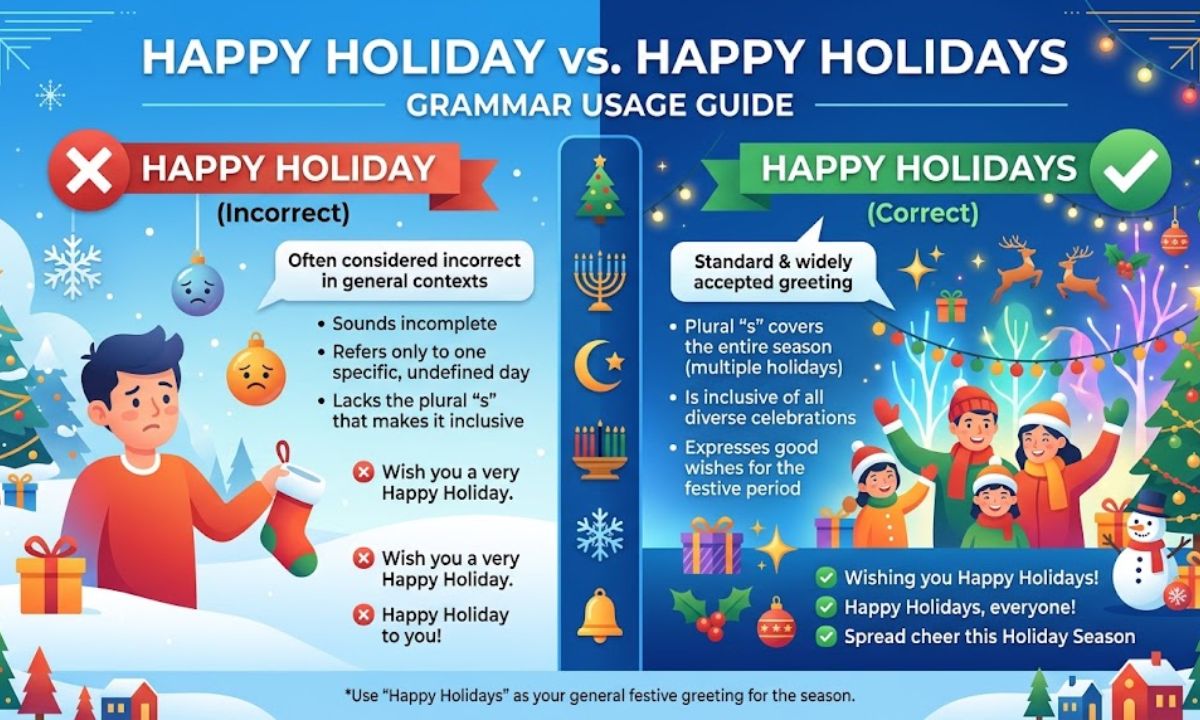
Happy Holidays is the standard greeting. Use “happy holiday” only when you mean one specific holiday or a single vacation. Both phrases are grammatically correct, but they carry different meanings.
Every December the same question comes up. Do you write “happy holiday or happy holidays” on your card? Should the email sign-off be singular or plural? One small “s” changes the meaning, the tone, and sometimes the audience.
This guide explains the difference in plain language. You will find clear examples, a comparison table, capitalization rules, and the mistakes people make most often.
What Does “Happy Holidays” Mean?
“Happy Holidays” is a general seasonal greeting. It wishes someone well across the whole festive period, not just one day. In the United States and Canada, that period usually runs from Thanksgiving through New Year’s Day.
The plural form covers several celebrations at once. Those can include Christmas, Hanukkah, Kwanzaa, Diwali, Winter Solstice, and New Year’s Eve. This is why the greeting feels inclusive and works for almost anyone.
Here is a quick definition for easy reference:
Happy Holidays is a plural, all-purpose seasonal greeting that wishes someone joy during the whole holiday season, without naming one specific celebration.
Examples of “Happy Holidays” Used Correctly
These sentences show the greeting in natural use:
- “Happy Holidays, team! Thank you for an amazing year.”
- “Wishing you and your family happy holidays and a peaceful new year.”
- “Happy Holidays from all of us at Greenfield Dental.”
- “Happy holidays, everyone! See you in January.”
- “Sending warm holiday wishes to our customers. Happy Holidays!”
Notice that none of these names a particular festival. The greeting stays open and friendly.
What Does “Happy Holiday” Mean?
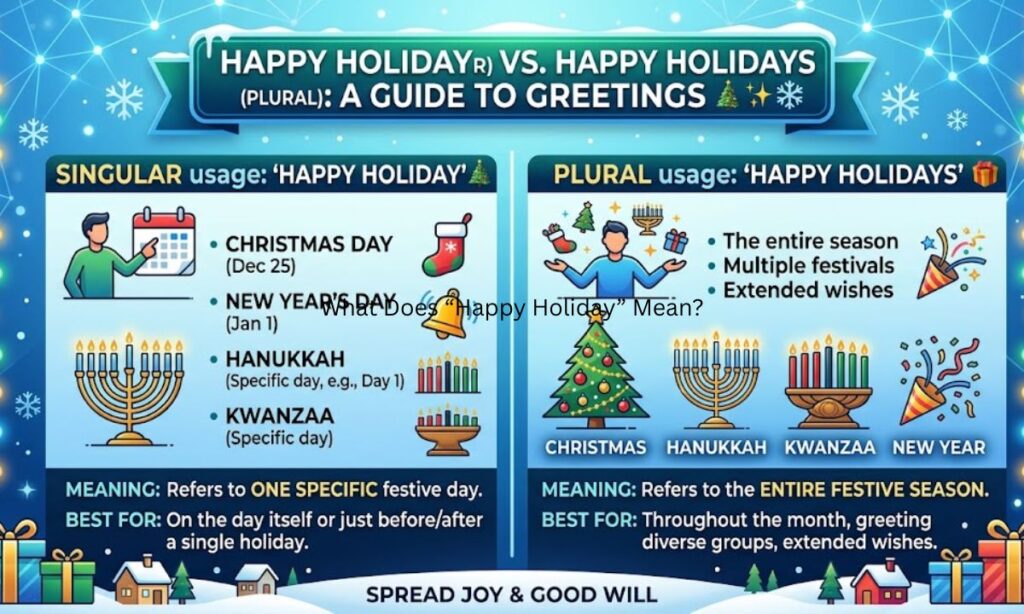
“Happy Holiday” in the singular points to one specific day, one occasion, or one trip. It works like any other singular noun phrase.
In British English, “holiday” also means a vacation. So “Have a happy holiday” can mean “Enjoy your trip.” That meaning is common in the UK, Australia, and India.
The singular form is not wrong. It is simply narrower. It fits when the sentence clearly refers to one event or one getaway.
Examples of “Happy Holiday” Used Correctly
- “Happy holiday! Enjoy your week in Spain.”
- “Have a happy holiday in the mountains.”
- “Happy Holiday to everyone celebrating Eid today.”
- “Wishing you a happy holiday on Independence Day.”
- “Enjoy your holiday, and send us a postcard.”
Each example points to a single event or trip. That clear focus is what makes the singular form work.
Happy Holiday vs Happy Holidays — Core Comparison
The simplest way to choose is to ask yourself one question: How many holidays am I talking about?
| Feature | Happy Holiday | Happy Holidays |
| Number | Singular | Plural |
| Meaning | One specific day or a vacation | The whole festive season |
| Tone | Personal and specific | Warm and inclusive |
| Best audience | Someone on a trip or celebrating one named day | Customers, colleagues, strangers, groups |
| Common region | UK, Australia, India (vacation sense) | US, Canada, worldwide |
| Typical use | Travel and single-day wishes | Cards, emails, social media, signs |
| Example | “Happy holiday in Goa!” | “Happy Holidays from our family to yours.” |
Both forms often appear with a group word. Here is how that looks:
- Happy Holidays everyone is the short version, common on social media captions.
- Happy holidays everyone wishes appears when someone is reporting the greeting, as in “Happy holidays, everyone wishes each other in December.”
Remember that “everyone” works with either form, but the plural remains the safer choice for a group message.
Why “Happy Holidays” Became the Standard Greeting
The plural greeting did not appear overnight. It grew from a mix of history, commerce, and changing communities.
- Early usage. The phrase appeared in print and in popular songs by the early twentieth century. It was a natural way to cover Christmas and New Year together.
- Retail adoption. Stores wanted one slogan that worked for every shopper across a long sales season.
- Growing diversity. As communities became more varied, people wanted a greeting that welcomed many traditions at once.
- Workplace norms. Companies adopted the phrase in policies, newsletters, and party invitations to include every employee.
- Digital communication. Short, universal greetings spread quickly on email, text, and social platforms.
Today the plural form is simply the default. It saves you from guessing which celebration someone observes. It also sounds friendly instead of formal.
Some people still prefer “Merry Christmas,” and that is perfectly fine. The point is to choose the wording that fits the person you are greeting.
When to Use “Happy Holidays” — Practical Contexts
Use the plural when your message goes to many people or when you are unsure which holiday they celebrate. Here are the most common situations.
Professional Emails and Business Communication
In a business setting, the plural form is the safe and polite choice. It includes everyone on the team, every client, and every vendor.
Good places to use it:
- Email sign-offs in late November and December
- Out-of-office replies during the break
- Company newsletters and year-end announcements
- Holiday party invitations
- Client thank-you notes
Sample email closing:
“Thank you for your partnership this year. Our office will close from December 24 to January 1. Happy Holidays from all of us!”
It reads as professional, warm, and inclusive without extra effort.
Greeting Cards and Social Media
Cards and posts often reach a mixed audience. The plural greeting fits almost every case.
- Printed cards: “Happy Holidays and best wishes for the new year.”
- Instagram captions: “Happy holidays, everyone! Cozy nights and good food ahead.”
- Brand posts: “Happy Holidays from our family to yours.”
- Photo cards: Pair the greeting with a family photo for a personal touch.
Keep it short. A simple line with one emoji performs better than a long paragraph.
Greeting Strangers or Acquaintances
When you do not know someone’s traditions, “Happy Holidays” is the kind option. Cashiers, neighbors, delivery drivers, and new coworkers all appreciate a friendly, neutral wish.
Quick tip: if you know the person celebrates a certain holiday, name it. A specific wish feels more personal than a general one.
When to Use “Happy Holiday” — Practical Contexts
Choose the singular when the wish is about one thing only.
Referring to a Personal Trip or Vacation
In British and Commonwealth English, “holiday” means vacation. So the singular form is natural here.
- “Have a happy holiday, and take lots of photos!”
- “Enjoy your holiday in Lisbon.”
- “I hope your holiday is relaxing.”
If your reader is in the US, “vacation” may sound more familiar. Adjust to your audience.
Wishing Someone Well on a Specific Named Holiday
Use the singular when you are naming a single celebration.
- “Happy Holiday to all who celebrate Hanukkah tonight.”
- “Wishing you a happy holiday on Thanksgiving.”
- “Happy Labor Day holiday!”
In these cases the sentence already points to one occasion, so the singular is accurate and clear. Many people simply drop the word and say “Happy Thanksgiving” instead, which is even shorter.
Capitalization Rules for Happy Holidays
Capitalization depends on where the phrase appears. Follow these simple rules.
| Situation | Correct Form | Example |
| Start of a sentence | Capitalize | “Happy holidays to you all.” |
| Standalone greeting or card heading | Capitalize both words | “Happy Holidays!” |
| Inside a sentence | Lowercase | “We wish you happy holidays and good health.” |
| Proper holiday name | Capitalize the name | “Happy Thanksgiving” |
| Email subject line | Title case is common | “Happy Holidays from Our Team” |
A few extra points:
- Capitalizing both words is common on cards and signs. It treats the phrase like a title.
- Lowercase is fine mid-sentence because it is not a proper noun.
- Whichever style you choose, stay consistent throughout the document.
Style guides such as AP and Chicago treat it like any common phrase. Capitals are for the start of a sentence or a title.
Common Mistakes to Avoid
Small errors can make a greeting look careless. Watch out for these.
- Using “Happy Holiday” for the whole season. The singular narrows the wish and can feel odd on a mass email.
- Adding an apostrophe. “Happy Holiday’s” is wrong. The word is a plain plural, not a possessive.
- Mixing capitalization. Avoid “happy Holidays” or “Happy holidays” inside the same card unless you have a reason.
- Forgetting the audience. A British reader may read “holiday” as a vacation, while a US reader expects a festive season.
- Overusing exclamation marks. One is plenty. Three look pushy.
- Assuming everyone celebrates Christmas. If you are unsure, the plural greeting avoids the guess.
- Skipping a personal touch. A name or a short note makes any greeting warmer.
Quick fix:
Read your message aloud. If the sentence sounds like it is about one day or one trip, use the singular. Otherwise, use the plural.
Frequently Asked Question
Is it “happy holiday” or “happy holidays”?
Use “happy holidays” for the general festive season and “happy holiday” only for one specific day or a single trip.
Why do people say “Happy Holidays” instead of “Merry Christmas”?
Happy Holidays covers many celebrations at once, so it includes people of different faiths and traditions. Merry Christmas remains perfectly fine when you know the person celebrates it.
Is “Happy Holiday” grammatically incorrect?
No. It is grammatically correct but narrower, because it refers to a single holiday or vacation.
Should I write “Happy Holidays” with capital letters?
Capitalize it at the start of a sentence or as a standalone greeting, and keep it lowercase mid-sentence.
Can I use “Happy Holidays” in a professional email?
Yes. It is the most inclusive and widely accepted greeting for business messages, clients, and colleagues.
Conclusion
So, happy holiday or happy holidays? The answer is simple. Choose Happy Holidays for the festive season, for groups, and for anyone whose traditions you do not know. Choose Happy Holiday for a single named day or a personal vacation.
Keep your capitalization consistent, skip the apostrophe, and match the greeting to your audience. A thoughtful greeting takes only a few seconds, yet it can make the people who receive it feel remembered.So, happy holiday or happy holidays? The answer comes down to one question: how many holidays are you talking about? Use Happy Holidays when you mean the whole festive season, when you are writing to a group, or when you do not know which traditions someone follows. Use Happy Holiday when you mean one named day or a single vacation.

Liam Joseph Miller is an English language writer and content creator focused on grammar, spelling, vocabulary, and writing. He creates simple, easy-to-understand guides that help readers learn English and avoid common language mistakes. Through OkayMegazines, Liam shares practical explanations, examples, and useful language tips for students, writers, and everyday English learners.